Advertisements
Advertisements
प्रश्न
A boy of mass 50 kg running at 5 m/s jumps on to a 20 kg trolley travelling in the same direction at 1.5 m/s. What is their common velocity ?
Advertisements
उत्तर
Momentum = Momentum of the boy + Momentum of the trolley
= Mass of boy × velocity of boy +Mass of trolley × Velocity of trolley
Momentum = Mass of the boy and trolley × common velocity
⇒ 280 = (50+20) × common velocity
⇒ 280 = 70 × common velocity
⇒ `280/70` = common velocity
⇒ 4 = common velocity
Hence, common velocity is 4 m/s.
APPEARS IN
संबंधित प्रश्न
A nucleus is at rest in the laboratory frame of reference. Show that if it disintegrates into two smaller nuclei the products must move in opposite directions.
Explain why, it is easier to stop a tennis ball than a cricket ball moving with the same speed.
Explain how, a karate player can break a pile of tiles with a single blow of his hand.
What is the change in momentum of a car weighing 1500 kg when its speed increases from 36 km/h to 72 km/h uniformly ?
Fill in the following blanks with suitable words :
In collisions and explosions, the total _____________ remains constant, provided that no external _____________ acts.
Explain why, a cricket player moves his hands backwards while catching a fast cricket ball.
Why are car seat-belts designed to stretch some what in a collision ?
The troops (soldiers) equipped to be dropped by parachutes from an aircraft are called paratroopers. Why do paratroopers roll on landing ?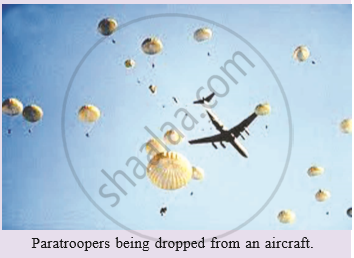
A man wearing a bullet-proof vest stands still on roller skates. The total mass is 80 kg. A bullet of mass 20 grams is fired at 400 m/s. It is stopped by the vest and falls to the ground. What is then the velocity of the man?
Two billiard balls A and B, each of mass 50 g and moving in opposite directions with speed of 5 ms–1 each, collide and rebound with the same speed. If the collision lasts for 10–3 s, which of the following statements are true?
- The impulse imparted to each ball is 0.25 kg ms–1 and the force on each ball is 250 N.
- The impulse imparted to each ball is 0.25 kg ms–1 and the force exerted on each ball is 25 × 10–5 N.
- The impulse imparted to each ball is 0.5 Ns.
- The impulse and the force on each ball are equal in magnitude and opposite in direction.
