Advertisements
Advertisements
प्रश्न
Explain why it is possible for a small animal to fall from a considerable height without any injury being caused when it reaches the ground.
Advertisements
उत्तर
Small animals have low mass and hence their momentum is small. So, when they fall from a considerable height, their momentum is not large enough to cause considerable damage to their bodies. However, falling from too great a height will definitely kill them.
APPEARS IN
संबंधित प्रश्न
What is the SI unit of momentum ?
What is the change in momentum of a car weighing 1500 kg when its speed increases from 36 km/h to 72 km/h uniformly ?
Which physical principle is involved in the working of a jet aeroplane ?
Fill in the following blanks with suitable words :
Momentum is a _____________ quantity. Its unit is _____________.
A body of mass 2 kg is at rest. What should be the magnitude of force which will make the body move with a speed of 30 m/s at the end of 1 s ?
A 150 g ball, travelling at 30 m/s, strikes the palm of a player’s hand and is stopped in 0.05 second. Find the force exerted by the ball on the hand.
Discuss the conservation of momentum in each of the following cases :
(i) a rocket taking off from ground.
(ii) flying of a jet aeroplane.
An unloaded truck weighing 2000 kg has a maximum acceleration of 0.5 m/s2. What is the maximum acceleration when it is carrying a load of 2000 kg ?
A truck of mass 500 kg moving at 4 m/s collides with another truck of mass 1500 kg moving in the same direction at 2 m/s. What is their common velocity just after the collision if they move off together ?
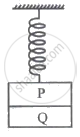
Two blocks P and Q of masses 0.3 kg and 0.4 kg, respectively, are stuck to each other by some weak glue as shown in the figure. They hang together at the end of a spring with a spring constant of k = 200 N/m. The block Q suddenly falls free due to the failure of glue, then the maximum kinetic energy of block P during subsequent motion will be ______ mJ.