Advertisements
Advertisements
प्रश्न
A truck of mass 500 kg moving at 4 m/s collides with another truck of mass 1500 kg moving in the same direction at 2 m/s. What is their common velocity just after the collision if they move off together ?
Advertisements
उत्तर
Common velocity just after the collision if they move off together will be :
`v = ((m_1 xx u_1)+(m_2+u_2))/(m_1+m_2)`
`m_1 = 500` kg,
`u_1` = 4 m/s
`m_2` = 1500 kg
`u_2` = 2 m/s
`v = ((500+4)+(1500xx2))/(500+1500)`
⇒ `v = (2000+3000)/2000`
⇒ `v = 5000/2000`
⇒ `v = 5000/2000`
⇒ v = 2.5 m/s
This is their common velocity after collision .
APPEARS IN
संबंधित प्रश्न
From a rifle of mass 4 kg, a bullet of mass 50 g is fired with an initial velocity of 35 m s−1. Calculate the initial recoil velocity of the rifle.
Two objects of masses 100 g and 200 g are moving along the same line and direction with velocities of 2 m s−1 and 1 m s−1, respectively. They collide and after the collision, the first object moves at a velocity of 1.67 m s−1. Determine the velocity of the second object.
What is the momentum in kg.m/s of a 10 kg car travelling at (a) 5 m/s (b) 20 cm/s, and (c) 36 km/h ?
Fill in the following blanks with suitable words :
Momentum is a _____________ quantity. Its unit is _____________.
Explain why, a cricket player moves his hands backwards while catching a fast cricket ball.
Why are car seat-belts designed to stretch some what in a collision ?
Explain why it is possible for a small animal to fall from a considerable height without any injury being caused when it reaches the ground.
A ball X of mass 1 kg travelling at 2 m/s has a head-on collision with an identical ball Y at rest. X stops and Y moves off. Calculate the velocity of Y after the collision.
A girl riding a bicycle along a straight road with a speed of 5 ms–1 throws a stone of mass 0.5 kg which has a speed of 15 ms–1 with respect to the ground along her direction of motion. The mass of the girl and bicycle is 50 kg. Does the speed of the bicycle change after the stone is thrown? What is the change in speed, if so?
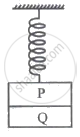
Two blocks P and Q of masses 0.3 kg and 0.4 kg, respectively, are stuck to each other by some weak glue as shown in the figure. They hang together at the end of a spring with a spring constant of k = 200 N/m. The block Q suddenly falls free due to the failure of glue, then the maximum kinetic energy of block P during subsequent motion will be ______ mJ.