Advertisements
Advertisements
प्रश्न
An object of mass 1 kg travelling in a straight line with a velocity of 10 ms−1 collides with, and sticks to, a stationary wooden block of mass 5 kg. Then they both move off together in the same straight line. Calculate the total momentum just before the impact and just after the impact. Also, calculate the velocity of the combined object.
Advertisements
उत्तर
Mass of object, m1 = 1 kg
The velocity of an object before the collision, u1 = 10 m s-1
Mass of wooden block, m2 = 5 kg
The velocity of the wooden block before the collision, u2= 0
(i) ∴ Total momentum before the impact = m1 u1 + m2 u2
= 1 × 10 + 5 × 0
= 10 kg ms-1
According to the law of conservation of momentum (as no net external force acts on the system),
Total momentum after the impact = Total momentum before the impact = 10 kg ms-1
(ii) Mass of combined object, M = mass of object + mass of block
= 1 + 5
= 6 kg
Let V = Velocity of the combined object after collision
∴ Momentum of combined object = MV
= (6V) kg ms-1
Now, the momentum of the combined object Total momentum after the impact
i.e., 6V = 10
or V = `10/6`
= 1.67 ms-1
संबंधित प्रश्न
Calculate the change in momentum of a body weighing 5 kg when its velocity decreases from 20 m/s to 0.20 m/s.
State the relation between the momentum of a body and the force acting on it.
Name the principle on which a rocket works.
Fill in the following blanks with suitable words :
In collisions and explosions, the total _____________ remains constant, provided that no external _____________ acts.
The troops (soldiers) equipped to be dropped by parachutes from an aircraft are called paratroopers. Why do paratroopers roll on landing ?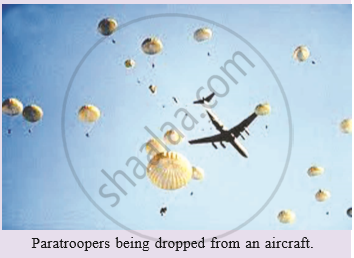
Why would an aircraft be unable to fly on the moon ?
Explain why it is possible for a small animal to fall from a considerable height without any injury being caused when it reaches the ground.
A truck of mass 500 kg moving at 4 m/s collides with another truck of mass 1500 kg moving in the same direction at 2 m/s. What is their common velocity just after the collision if they move off together ?
A man wearing a bullet-proof vest stands still on roller skates. The total mass is 80 kg. A bullet of mass 20 grams is fired at 400 m/s. It is stopped by the vest and falls to the ground. What is then the velocity of the man?
Two billiard balls A and B, each of mass 50 g and moving in opposite directions with speed of 5 ms–1 each, collide and rebound with the same speed. If the collision lasts for 10–3 s, which of the following statements are true?
- The impulse imparted to each ball is 0.25 kg ms–1 and the force on each ball is 250 N.
- The impulse imparted to each ball is 0.25 kg ms–1 and the force exerted on each ball is 25 × 10–5 N.
- The impulse imparted to each ball is 0.5 Ns.
- The impulse and the force on each ball are equal in magnitude and opposite in direction.
