Advertisements
Advertisements
प्रश्न
Akhtar, Kiran and Rahul were riding in a motorcar that was moving with a high velocity on an expressway when an insect hit the windshield and got stuck on the windscreen. Akhtar and Kiran started pondering over the situation. Kiran suggested that the insect suffered a greater change in momentum as compared to the change in momentum of the motorcar (because the change in the velocity of the insect was much more than that of the motorcar). Akhtar said that since the motorcar was moving with a larger velocity, it exerted a larger force on the insect. And as a result the insect died. Rahul while putting an entirely new explanation said that both the motorcar and the insect experienced the same force and a change in their momentum. Comment on these suggestions.
Advertisements
उत्तर
According to the law of conservation of momentum:
Momentum of the car and insect system before collision = Momentum of the car and insect system after collision
Hence, the change in momentum of the car and insect system is zero.
- Kiran's fallacy is that the magnitude of change in momentum of the insect is much greater than the magnitude of change in momentum of the car. His argument is wrong. The velocity of the car was very high; basically, the car applied a lot of force on the insect, Akhtar's argument is also wrong.
- Rahul's argument is correct. Equal force is applied to both because reaction is opposite to action. Also, the magnitude of change in momentum is also the same, while momentum is conserved during collision.
- Akhtar made a correct conclusion because the mass of the car is very large as compared to the mass of the insect.
संबंधित प्रश्न
From a rifle of mass 4 kg, a bullet of mass 50 g is fired with an initial velocity of 35 m s−1. Calculate the initial recoil velocity of the rifle.
A nucleus is at rest in the laboratory frame of reference. Show that if it disintegrates into two smaller nuclei the products must move in opposite directions.
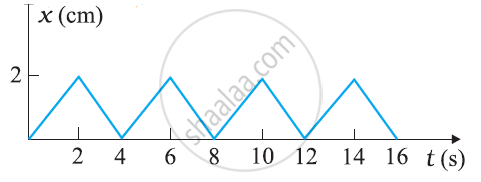
Figure shows the position-time graph of a body of mass 0.04 kg. Suggest a suitable physical context for this motion. What is the time between two consecutive impulses received by the body ? What is the magnitude of each impulse ?
Name the physical quantity which is considered to be a measure of the quantity of motion of a body.
Explain how, a karate player can break a pile of tiles with a single blow of his hand.
State the relation between the momentum of a body and the force acting on it.
Name the principle on which a rocket works.
A body of mass 2 kg is at rest. What should be the magnitude of force which will make the body move with a speed of 30 m/s at the end of 1 s ?
A boy of mass 50 kg running at 5 m/s jumps on to a 20 kg trolley travelling in the same direction at 1.5 m/s. What is their common velocity ?
A man wearing a bullet-proof vest stands still on roller skates. The total mass is 80 kg. A bullet of mass 20 grams is fired at 400 m/s. It is stopped by the vest and falls to the ground. What is then the velocity of the man?
