Advertisements
Advertisements
प्रश्न
A stream of water flowing horizontally with a speed of 15 m s–1 gushes out of a tube of cross-sectional area 10–2 m2, and hits a vertical wall nearby. What is the force exerted on the wall by the impact of water, assuming it does not rebound?
Advertisements
उत्तर १
Speed of the water stream, v = 15 m/s
Cross-sectional area of the tube, A = 10–2 m2
Volume of water coming out from the pipe per second,
V = Av = 15 × 10–2 m3/s
Density of water, ρ = 103 kg/m3
Mass of water flowing out through the pipe per second = ρ × V = 150 kg/s
The water strikes the wall and does not rebound. Therefore, the force exerted by the water on the wall is given by Newton’s second law of motion as:
F = Rate of change of momentum = `(triangleP)/(trianglet)`
`= "mv"/t`
= 150 x 15 = 2250 N
उत्तर २
In one second, the distance travelled is equal to the velocity v.
Volume of water hitting the wall per second, V = av where a is the cross-sectional area of the tube and v is the speed of water coming out of the tube.
V = 10-2 m2 x 15 ms-1 = 15 x 10-2 m3 s-1
Mass of water hitting the wall per second = 15 x 10-2 x 103 kg s-1 = 150 kg s-1 [v density of water = 1000 kg m-3] Initial momentum of water hitting the wall per second
= 150 kg s-1 x 15 ms-1 = 2250 kg ms-2 or 2250 N Final momentum per second = 0
Force exerted by the wall = 0 – 2250 N = – 2250 N Force exerted on the wall = – (- 2250) N = 2250 N.
संबंधित प्रश्न
From a rifle of mass 4 kg, a bullet of mass 50 g is fired with an initial velocity of 35 m s−1. Calculate the initial recoil velocity of the rifle.
Two objects of masses 100 g and 200 g are moving along the same line and direction with velocities of 2 m s−1 and 1 m s−1, respectively. They collide and after the collision, the first object moves at a velocity of 1.67 m s−1. Determine the velocity of the second object.
Two objects, each of mass 1.5 kg are moving in the same straight line but in opposite directions. The velocity of each object is 2.5 m s−1 before the collision during which they stick together. What will be the velocity of the combined object after collision?
Akhtar, Kiran and Rahul were riding in a motorcar that was moving with a high velocity on an expressway when an insect hit the windshield and got stuck on the windscreen. Akhtar and Kiran started pondering over the situation. Kiran suggested that the insect suffered a greater change in momentum as compared to the change in momentum of the motorcar (because the change in the velocity of the insect was much more than that of the motorcar). Akhtar said that since the motorcar was moving with a larger velocity, it exerted a larger force on the insect. And as a result the insect died. Rahul while putting an entirely new explanation said that both the motorcar and the insect experienced the same force and a change in their momentum. Comment on these suggestions.
A shell of mass 0.020 kg is fired by a gun of mass 100 kg. If the muzzle speed of the shell is 80 m s–1, what is the recoil speed of the gun?
Figure shows the position-time graph of a body of mass 0.04 kg. Suggest a suitable physical context for this motion. What is the time between two consecutive impulses received by the body ? What is the magnitude of each impulse ?
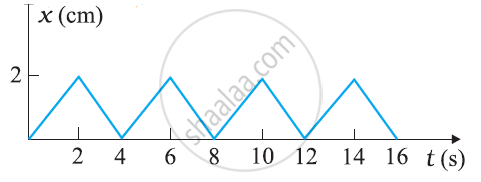
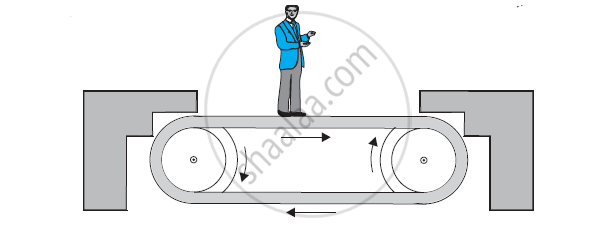
Figure shows a man standing stationary with respect to a horizontal conveyor belt that is accelerating with 1 m s–2. What is the net force on the man? If the coefficient of static friction between the man’s shoes and the belt is 0.2, up to what acceleration of the belt can the man continue to be stationary relative to the belt? (Mass of the man = 65 kg.)
Name the physical quantity which is considered to be a measure of the quantity of motion of a body.
Explain why, it is easier to stop a tennis ball than a cricket ball moving with the same speed.
What is the momentum in kg.m/s of a 10 kg car travelling at (a) 5 m/s (b) 20 cm/s, and (c) 36 km/h ?
Which physical principle is involved in the working of a jet aeroplane ?
Fill in the following blanks with suitable words :
Momentum is a _____________ quantity. Its unit is _____________.
A body of mass 2 kg is at rest. What should be the magnitude of force which will make the body move with a speed of 30 m/s at the end of 1 s ?
Explain why, a cricket player moves his hands backwards while catching a fast cricket ball.
Why would an aircraft be unable to fly on the moon ?
A boy of mass 50 kg running at 5 m/s jumps on to a 20 kg trolley travelling in the same direction at 1.5 m/s. What is their common velocity ?
The rockets work on the principle of conservation of :
A vessel at rest explodes into three pieces. Two pieces having equal masses fly-off perpendicular to one another with the same velocity 30 meter per second. The third piece has three times mass of each of other piece. The magnitude and direction of the velocity of the third piece will be
A monkey of mass 20 kg rides on a 40 kg trolley moving with constant speed of 8 m/s along a horizontal track If the monkey jumps vertically to grab the overhanging branch of a tree, the speed of the trolley after the monkey has jumped off is ______.
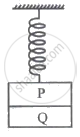
Two blocks P and Q of masses 0.3 kg and 0.4 kg, respectively, are stuck to each other by some weak glue as shown in the figure. They hang together at the end of a spring with a spring constant of k = 200 N/m. The block Q suddenly falls free due to the failure of glue, then the maximum kinetic energy of block P during subsequent motion will be ______ mJ.