Advertisements
Advertisements
प्रश्न
A stream of water flowing horizontally with a speed of 15 m s–1 gushes out of a tube of cross-sectional area 10–2 m2, and hits a vertical wall nearby. What is the force exerted on the wall by the impact of water, assuming it does not rebound?
Advertisements
उत्तर १
Speed of the water stream, v = 15 m/s
Cross-sectional area of the tube, A = 10–2 m2
Volume of water coming out from the pipe per second,
V = Av = 15 × 10–2 m3/s
Density of water, ρ = 103 kg/m3
Mass of water flowing out through the pipe per second = ρ × V = 150 kg/s
The water strikes the wall and does not rebound. Therefore, the force exerted by the water on the wall is given by Newton’s second law of motion as:
F = Rate of change of momentum = `(triangleP)/(trianglet)`
`= "mv"/t`
= 150 x 15 = 2250 N
उत्तर २
In one second, the distance travelled is equal to the velocity v.
Volume of water hitting the wall per second, V = av where a is the cross-sectional area of the tube and v is the speed of water coming out of the tube.
V = 10-2 m2 x 15 ms-1 = 15 x 10-2 m3 s-1
Mass of water hitting the wall per second = 15 x 10-2 x 103 kg s-1 = 150 kg s-1 [v density of water = 1000 kg m-3] Initial momentum of water hitting the wall per second
= 150 kg s-1 x 15 ms-1 = 2250 kg ms-2 or 2250 N Final momentum per second = 0
Force exerted by the wall = 0 – 2250 N = – 2250 N Force exerted on the wall = – (- 2250) N = 2250 N.
संबंधित प्रश्न
A hockey ball of mass 200 g travelling at 10 m s−1 is struck by a hockey stick so as to return it along its original path with a velocity at 5 m s−1. Calculate the change of momentum occurred in the motion of the hockey ball by the force applied by the hockey stick.
A shell of mass 0.020 kg is fired by a gun of mass 100 kg. If the muzzle speed of the shell is 80 m s–1, what is the recoil speed of the gun?
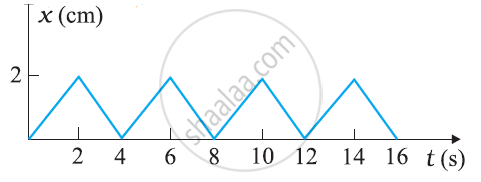
Figure shows the position-time graph of a body of mass 0.04 kg. Suggest a suitable physical context for this motion. What is the time between two consecutive impulses received by the body ? What is the magnitude of each impulse ?
Name the physical quantity which is considered to be a measure of the quantity of motion of a body.
Name the physical quantity whose unit is kg.m/s.
Explain why, it is easier to stop a tennis ball than a cricket ball moving with the same speed.
Explain the meaning of the following equation : .
p = m x v
where symbols have their usual meanings.
A plastic ball and a clay ball of equal masses, travelling in the same direction with equal speeds, strike against a vertical wall. From which ball does the wall receive a greater amount of momentum ?
Which physical quantity corresponds to the rate of change of momentum ?
Fill in the following blanks with suitable words :
In collisions and explosions, the total _____________ remains constant, provided that no external _____________ acts.
Explain why, a cricket player moves his hands backwards while catching a fast cricket ball.
A 150 g ball, travelling at 30 m/s, strikes the palm of a player’s hand and is stopped in 0.05 second. Find the force exerted by the ball on the hand.
The troops (soldiers) equipped to be dropped by parachutes from an aircraft are called paratroopers. Why do paratroopers roll on landing ?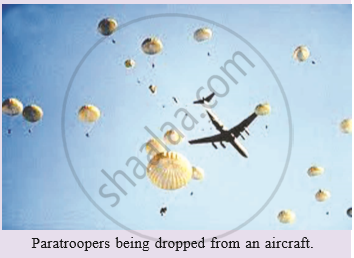
Why would an aircraft be unable to fly on the moon ?
A boy of mass 50 kg running at 5 m/s jumps on to a 20 kg trolley travelling in the same direction at 1.5 m/s. What is their common velocity ?
A ball X of mass 1 kg travelling at 2 m/s has a head-on collision with an identical ball Y at rest. X stops and Y moves off. Calculate the velocity of Y after the collision.
A man wearing a bullet-proof vest stands still on roller skates. The total mass is 80 kg. A bullet of mass 20 grams is fired at 400 m/s. It is stopped by the vest and falls to the ground. What is then the velocity of the man?
The rockets work on the principle of conservation of :
