Advertisements
Advertisements
प्रश्न
An unloaded truck weighing 2000 kg has a maximum acceleration of 0.5 m/s2. What is the maximum acceleration when it is carrying a load of 2000 kg ?
Advertisements
उत्तर
Force of unloaded truck:
m = 2000 kg
a = 0.5 m/s2
Force = mass × acceleration
= 0.5 × 2000
= 1000 N
Force of loaded truck:
We have to find maximum acceleration,
M = [2000+2000]
Force = mass × acceleration
⇒ 1000 = a × 4000
⇒ `1000/4000 = a`
⇒ a = 0.25
The maximum acceleration when it is carrying a load of 2000 kg is 0.25 m/s2.
APPEARS IN
संबंधित प्रश्न
Two objects, each of mass 1.5 kg are moving in the same straight line but in opposite directions. The velocity of each object is 2.5 m s−1 before the collision during which they stick together. What will be the velocity of the combined object after collision?
Name the physical quantity whose unit is kg.m/s.
What is the momentum in kg.m/s of a 10 kg car travelling at (a) 5 m/s (b) 20 cm/s, and (c) 36 km/h ?
A 10 g bullet travelling at 200 m/s strikes and remains embedded in a 2 kg target which is originally at rest but free to move. At what speed does the target move off ?
Name the law involved in the following situation :
the sum of products of masses and velocities of two moving bodies before and after their collision remains the same.
Explain why, a cricket player moves his hands backwards while catching a fast cricket ball.
Why are car seat-belts designed to stretch some what in a collision ?
A man wearing a bullet-proof vest stands still on roller skates. The total mass is 80 kg. A bullet of mass 20 grams is fired at 400 m/s. It is stopped by the vest and falls to the ground. What is then the velocity of the man?
A monkey of mass 20 kg rides on a 40 kg trolley moving with constant speed of 8 m/s along a horizontal track If the monkey jumps vertically to grab the overhanging branch of a tree, the speed of the trolley after the monkey has jumped off is ______.
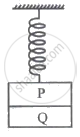
Two blocks P and Q of masses 0.3 kg and 0.4 kg, respectively, are stuck to each other by some weak glue as shown in the figure. They hang together at the end of a spring with a spring constant of k = 200 N/m. The block Q suddenly falls free due to the failure of glue, then the maximum kinetic energy of block P during subsequent motion will be ______ mJ.