Advertisements
Advertisements
प्रश्न
The velocity of a body of mass 10 kg increases from 4 m/s to 8 m/s when a force acts on it for 2 s.
(a) What is the momentum before the force acts ?
(b) What is the momentum after the force acts ?
(c) What is the gain in momentum per second ?
(d) What is the value of the force ?
Advertisements
उत्तर
(a) Momentum = Mass × velocity
= 10 × 4
= 40 kg.m/s
(b) Momentum = Mass × velocity
= 10 × 8
= 80 kg.m/s
(c) The gain in momentum per second = Momentum Gaintime
= `(80-40)/2`
= `40/2`
= 20 `"kg.m/s"^2`
(d) Force is the rate of change of momentum or the momentum gain or lost per second.
So, force = 20 kg.ms/2 = 20 N
APPEARS IN
संबंधित प्रश्न
From a rifle of mass 4 kg, a bullet of mass 50 g is fired with an initial velocity of 35 m s−1. Calculate the initial recoil velocity of the rifle.
A hockey ball of mass 200 g travelling at 10 m s−1 is struck by a hockey stick so as to return it along its original path with a velocity at 5 m s−1. Calculate the change of momentum occurred in the motion of the hockey ball by the force applied by the hockey stick.
A shell of mass 0.020 kg is fired by a gun of mass 100 kg. If the muzzle speed of the shell is 80 m s–1, what is the recoil speed of the gun?
What is the total momentum of the bullet and the gun before firing ?
Explain how, a karate player can break a pile of tiles with a single blow of his hand.
A plastic ball and a clay ball of equal masses, travelling in the same direction with equal speeds, strike against a vertical wall. From which ball does the wall receive a greater amount of momentum ?
State the relation between the momentum of a body and the force acting on it.
Which physical principle is involved in the working of a jet aeroplane ?
The troops (soldiers) equipped to be dropped by parachutes from an aircraft are called paratroopers. Why do paratroopers roll on landing ?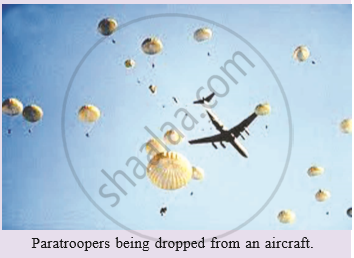
A monkey of mass 20 kg rides on a 40 kg trolley moving with constant speed of 8 m/s along a horizontal track If the monkey jumps vertically to grab the overhanging branch of a tree, the speed of the trolley after the monkey has jumped off is ______.
