Advertisements
Advertisements
Question
The velocity of a body of mass 10 kg increases from 4 m/s to 8 m/s when a force acts on it for 2 s.
(a) What is the momentum before the force acts ?
(b) What is the momentum after the force acts ?
(c) What is the gain in momentum per second ?
(d) What is the value of the force ?
Advertisements
Solution
(a) Momentum = Mass × velocity
= 10 × 4
= 40 kg.m/s
(b) Momentum = Mass × velocity
= 10 × 8
= 80 kg.m/s
(c) The gain in momentum per second = Momentum Gaintime
= `(80-40)/2`
= `40/2`
= 20 `"kg.m/s"^2`
(d) Force is the rate of change of momentum or the momentum gain or lost per second.
So, force = 20 kg.ms/2 = 20 N
APPEARS IN
RELATED QUESTIONS
A hockey ball of mass 200 g travelling at 10 m s−1 is struck by a hockey stick so as to return it along its original path with a velocity at 5 m s−1. Calculate the change of momentum occurred in the motion of the hockey ball by the force applied by the hockey stick.
A plastic ball and a clay ball of equal masses, travelling in the same direction with equal speeds, strike against a vertical wall. From which ball does the wall receive a greater amount of momentum ?
Which physical quantity corresponds to the rate of change of momentum ?
Which physical principle is involved in the working of a jet aeroplane ?
A gun of mass 3 kg fires a bullet of mass 30 g. The bullet takes 0.003 s to move through the barrel of the gun and acquires a velocity of 100 m/s. Calculate:
- the velocity with which the gin recoils.
- the force exerted on gunman due to recoil of the gun
Discuss the conservation of momentum in each of the following cases :
(i) a rocket taking off from ground.
(ii) flying of a jet aeroplane.
The troops (soldiers) equipped to be dropped by parachutes from an aircraft are called paratroopers. Why do paratroopers roll on landing ?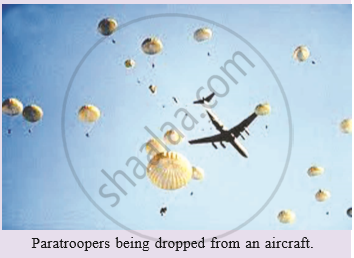
A man wearing a bullet-proof vest stands still on roller skates. The total mass is 80 kg. A bullet of mass 20 grams is fired at 400 m/s. It is stopped by the vest and falls to the ground. What is then the velocity of the man?
Suppose a ball of mass m is thrown vertically upward with an initial speed v, its speed decreases continuously till it becomes zero. Thereafter, the ball begins to fall downward and attains the speed v again before striking the ground. It implies that the magnitude of the initial and final momentums of the ball are the same. Yet, it is not an example of conservation of momentum. Explain why?
A girl riding a bicycle along a straight road with a speed of 5 ms–1 throws a stone of mass 0.5 kg which has a speed of 15 ms–1 with respect to the ground along her direction of motion. The mass of the girl and bicycle is 50 kg. Does the speed of the bicycle change after the stone is thrown? What is the change in speed, if so?
