Advertisements
Advertisements
Question
From a rifle of mass 4 kg, a bullet of mass 50 g is fired with an initial velocity of 35 m s−1. Calculate the initial recoil velocity of the rifle.
Advertisements
Solution
Mass of the rifle, m1 = 4kg
Mass of the bullet, m2 = 50g = 0.05 kg
Recoil velocity of the rifle = v1
Bullet is fired with an initial velocity, v2 = 35 m/s
Initially, the rifle is at rest.
Thus, its initial velocity, v = 0
Total initial momentum of the rifle and bullet system (m1 + m2)v = 0
Total momentum of the rifle and bullet system after firing:-
= m1v1 + m2v2 = 4(v1) + 0.05 x 35 = 4v1 + 1.75
According to the law of conservation of momentum:
Total momentum after the firing = Total momentum before the firing
4v1 + 1.75 =0
`v_1 = 1.75/4 =-0.4375" m/s"`
The negative sign indicates that the rifle recoils backwards with a velocity of 0.4375 m/s.
RELATED QUESTIONS
Two objects of masses 100 g and 200 g are moving along the same line and direction with velocities of 2 m s−1 and 1 m s−1, respectively. They collide and after the collision, the first object moves at a velocity of 1.67 m s−1. Determine the velocity of the second object.
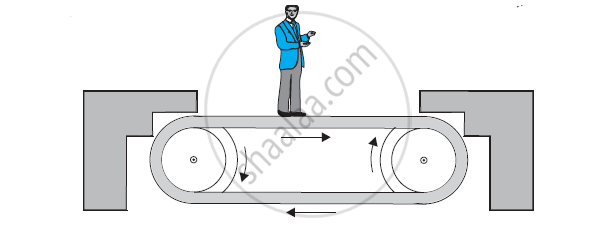
Figure shows a man standing stationary with respect to a horizontal conveyor belt that is accelerating with 1 m s–2. What is the net force on the man? If the coefficient of static friction between the man’s shoes and the belt is 0.2, up to what acceleration of the belt can the man continue to be stationary relative to the belt? (Mass of the man = 65 kg.)
Name the physical quantity which is considered to be a measure of the quantity of motion of a body.
Define momentum of a body. On what factors does the momentum of a body depend ?
Fill in the following blanks with suitable words :
Momentum is a _____________ quantity. Its unit is _____________.
A body of mass 2 kg is at rest. What should be the magnitude of force which will make the body move with a speed of 30 m/s at the end of 1 s ?
State the law of conservation of momentum.
Discuss the conservation of momentum in each of the following cases :
(i) a rocket taking off from ground.
(ii) flying of a jet aeroplane.
A girl of mass 50 kg jumps out of a rowing boat of mass 300 kg on to the bank, with a horizontal velocity of 3 m/s. With what velocity does the boat begin to move backwards ?
The rockets work on the principle of conservation of :
