Advertisements
Advertisements
Question
Which physical quantity corresponds to the rate of change of momentum ?
Advertisements
Solution
Force is the physical quantity which corresponds to the rate of change of momentum.
APPEARS IN
RELATED QUESTIONS
Name the physical quantity which is considered to be a measure of the quantity of motion of a body.
Name the physical quantity whose unit is kg.m/s.
State the relation between the momentum of a body and the force acting on it.
A 10 g bullet travelling at 200 m/s strikes and remains embedded in a 2 kg target which is originally at rest but free to move. At what speed does the target move off ?
An unloaded truck weighing 2000 kg has a maximum acceleration of 0.5 m/s2. What is the maximum acceleration when it is carrying a load of 2000 kg ?
Why would an aircraft be unable to fly on the moon ?
Explain why it is possible for a small animal to fall from a considerable height without any injury being caused when it reaches the ground.
A truck of mass 500 kg moving at 4 m/s collides with another truck of mass 1500 kg moving in the same direction at 2 m/s. What is their common velocity just after the collision if they move off together ?
A 100 kg gun fires a ball of 1 kg horizontally from a cliff of height 500 m. It falls on the ground at a distance of 400 m from the bottom of the cliff. Find the recoil velocity of the gun. (acceleration due to gravity = 10 ms–2)
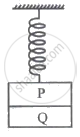
Two blocks P and Q of masses 0.3 kg and 0.4 kg, respectively, are stuck to each other by some weak glue as shown in the figure. They hang together at the end of a spring with a spring constant of k = 200 N/m. The block Q suddenly falls free due to the failure of glue, then the maximum kinetic energy of block P during subsequent motion will be ______ mJ.