Advertisements
Advertisements
Question
What is the SI unit of momentum ?
Advertisements
Solution
The SI unit of momentum is kilogram meters per second(kg.m/s).
APPEARS IN
RELATED QUESTIONS
Two billiard balls, each of mass 0.05 kg, moving in opposite directions with speed 6 ms-1collide and rebound with the same speed. What is the impulse imparted to each ball due to the other?
A shell of mass 0.020 kg is fired by a gun of mass 100 kg. If the muzzle speed of the shell is 80 m s–1, what is the recoil speed of the gun?
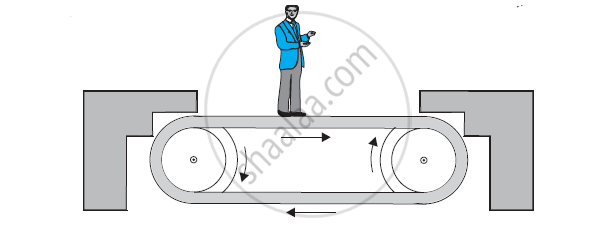
Figure shows a man standing stationary with respect to a horizontal conveyor belt that is accelerating with 1 m s–2. What is the net force on the man? If the coefficient of static friction between the man’s shoes and the belt is 0.2, up to what acceleration of the belt can the man continue to be stationary relative to the belt? (Mass of the man = 65 kg.)
Calculate the momentum of a toy car of mass 200 g moving with a speed of 5 m/s.
What is the momentum in kg.m/s of a 10 kg car travelling at (a) 5 m/s (b) 20 cm/s, and (c) 36 km/h ?
Calculate the change in momentum of a body weighing 5 kg when its velocity decreases from 20 m/s to 0.20 m/s.
A plastic ball and a clay ball of equal masses, travelling in the same direction with equal speeds, strike against a vertical wall. From which ball does the wall receive a greater amount of momentum ?
Which physical principle is involved in the working of a jet aeroplane ?
Why would an aircraft be unable to fly on the moon ?
Explain why it is possible for a small animal to fall from a considerable height without any injury being caused when it reaches the ground.
