Advertisements
Advertisements
Question
Explain the meaning of the following equation : .
p = m x v
where symbols have their usual meanings.
Advertisements
Solution
The given equation describes the momentum of a body as the product of its mass and velocity.
P = m × v
where, P = momentum
m = mass of the body
v = velocity of the body
APPEARS IN
RELATED QUESTIONS
A nucleus is at rest in the laboratory frame of reference. Show that if it disintegrates into two smaller nuclei the products must move in opposite directions.
What is the SI unit of momentum ?
Define momentum of a body. On what factors does the momentum of a body depend ?
State the relation between the momentum of a body and the force acting on it.
Fill in the following blanks with suitable words :
In collisions and explosions, the total _____________ remains constant, provided that no external _____________ acts.
A 150 g ball, travelling at 30 m/s, strikes the palm of a player’s hand and is stopped in 0.05 second. Find the force exerted by the ball on the hand.
An unloaded truck weighing 2000 kg has a maximum acceleration of 0.5 m/s2. What is the maximum acceleration when it is carrying a load of 2000 kg ?
Why would an aircraft be unable to fly on the moon ?
A boy of mass 50 kg running at 5 m/s jumps on to a 20 kg trolley travelling in the same direction at 1.5 m/s. What is their common velocity ?
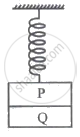
Two blocks P and Q of masses 0.3 kg and 0.4 kg, respectively, are stuck to each other by some weak glue as shown in the figure. They hang together at the end of a spring with a spring constant of k = 200 N/m. The block Q suddenly falls free due to the failure of glue, then the maximum kinetic energy of block P during subsequent motion will be ______ mJ.