Advertisements
Advertisements
Question
A girl of mass 50 kg jumps out of a rowing boat of mass 300 kg on to the bank, with a horizontal velocity of 3 m/s. With what velocity does the boat begin to move backwards ?
Advertisements
Solution
The force F1 exerted by girl is the ‘action’ and the force F2 exerted by the boat is the ‘reaction’.
Now, momentum of the girl in one direction must be equal to the momentum of the boat in opposite direction.
m1 × v1 = m2 × v2
⇒ 50 × 3 = 300 × v2
⇒ v2 = 0.5
Hence, velocity with which the boat begins to move backwards is 0.5 m/s.
APPEARS IN
RELATED QUESTIONS
A hockey ball of mass 200 g travelling at 10 m s−1 is struck by a hockey stick so as to return it along its original path with a velocity at 5 m s−1. Calculate the change of momentum occurred in the motion of the hockey ball by the force applied by the hockey stick.
A shell of mass 0.020 kg is fired by a gun of mass 100 kg. If the muzzle speed of the shell is 80 m s–1, what is the recoil speed of the gun?
What is the SI unit of momentum ?
Name the physical quantity whose unit is kg.m/s.
Explain how, a karate player can break a pile of tiles with a single blow of his hand.
Calculate the momentum of a toy car of mass 200 g moving with a speed of 5 m/s.
Fill in the following blanks with suitable words :
In collisions and explosions, the total _____________ remains constant, provided that no external _____________ acts.
The velocity of a body of mass 10 kg increases from 4 m/s to 8 m/s when a force acts on it for 2 s.
(a) What is the momentum before the force acts ?
(b) What is the momentum after the force acts ?
(c) What is the gain in momentum per second ?
(d) What is the value of the force ?
Suppose a ball of mass m is thrown vertically upward with an initial speed v, its speed decreases continuously till it becomes zero. Thereafter, the ball begins to fall downward and attains the speed v again before striking the ground. It implies that the magnitude of the initial and final momentums of the ball are the same. Yet, it is not an example of conservation of momentum. Explain why?
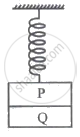
Two blocks P and Q of masses 0.3 kg and 0.4 kg, respectively, are stuck to each other by some weak glue as shown in the figure. They hang together at the end of a spring with a spring constant of k = 200 N/m. The block Q suddenly falls free due to the failure of glue, then the maximum kinetic energy of block P during subsequent motion will be ______ mJ.