Advertisements
Advertisements
Question
A truck of mass 500 kg moving at 4 m/s collides with another truck of mass 1500 kg moving in the same direction at 2 m/s. What is their common velocity just after the collision if they move off together ?
Advertisements
Solution
Common velocity just after the collision if they move off together will be :
`v = ((m_1 xx u_1)+(m_2+u_2))/(m_1+m_2)`
`m_1 = 500` kg,
`u_1` = 4 m/s
`m_2` = 1500 kg
`u_2` = 2 m/s
`v = ((500+4)+(1500xx2))/(500+1500)`
⇒ `v = (2000+3000)/2000`
⇒ `v = 5000/2000`
⇒ `v = 5000/2000`
⇒ v = 2.5 m/s
This is their common velocity after collision .
APPEARS IN
RELATED QUESTIONS
Name the physical quantity whose unit is kg.m/s.
Explain how, a karate player can break a pile of tiles with a single blow of his hand.
Calculate the change in momentum of a body weighing 5 kg when its velocity decreases from 20 m/s to 0.20 m/s.
Which physical principle is involved in the working of a jet aeroplane ?
A 10 g bullet travelling at 200 m/s strikes and remains embedded in a 2 kg target which is originally at rest but free to move. At what speed does the target move off ?
Explain why, a cricket player moves his hands backwards while catching a fast cricket ball.
A 150 g ball, travelling at 30 m/s, strikes the palm of a player’s hand and is stopped in 0.05 second. Find the force exerted by the ball on the hand.
State the law of conservation of momentum.
The troops (soldiers) equipped to be dropped by parachutes from an aircraft are called paratroopers. Why do paratroopers roll on landing ?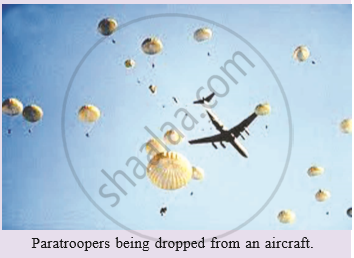
A girl riding a bicycle along a straight road with a speed of 5 ms–1 throws a stone of mass 0.5 kg which has a speed of 15 ms–1 with respect to the ground along her direction of motion. The mass of the girl and bicycle is 50 kg. Does the speed of the bicycle change after the stone is thrown? What is the change in speed, if so?
