Advertisements
Advertisements
Question
Two billiard balls A and B, each of mass 50 g and moving in opposite directions with speed of 5 ms–1 each, collide and rebound with the same speed. If the collision lasts for 10–3 s, which of the following statements are true?
- The impulse imparted to each ball is 0.25 kg ms–1 and the force on each ball is 250 N.
- The impulse imparted to each ball is 0.25 kg ms–1 and the force exerted on each ball is 25 × 10–5 N.
- The impulse imparted to each ball is 0.5 Ns.
- The impulse and the force on each ball are equal in magnitude and opposite in direction.
Advertisements
Solution
c and d
Explanation:
We are given that, m = 0.05 kg and v = 5 m/s
Hence we have initial momentum of each ball p = mv = 0.05 × 5 = 0.25 kg ms–1
After the collision, both balls will move in opposite directions
Hence, we have the final momentum of each ball p' = – mv = – 0.05 × 5 = – 0.25 kg ms–1
Now the impulse is the change in momentum,
Hence, I = p' – p = – 0.25 – 0.25 = – 0.5 kg ms–1.
APPEARS IN
RELATED QUESTIONS
A hockey ball of mass 200 g travelling at 10 m s−1 is struck by a hockey stick so as to return it along its original path with a velocity at 5 m s−1. Calculate the change of momentum occurred in the motion of the hockey ball by the force applied by the hockey stick.
A shell of mass 0.020 kg is fired by a gun of mass 100 kg. If the muzzle speed of the shell is 80 m s–1, what is the recoil speed of the gun?
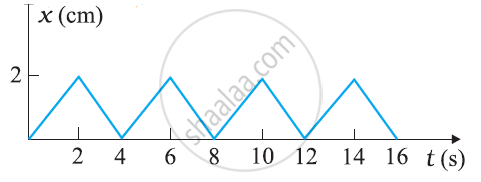
Figure shows the position-time graph of a body of mass 0.04 kg. Suggest a suitable physical context for this motion. What is the time between two consecutive impulses received by the body ? What is the magnitude of each impulse ?
What is the SI unit of momentum ?
state whether momentum is scalar or vector.
Explain why, it is easier to stop a tennis ball than a cricket ball moving with the same speed.
Explain how, a karate player can break a pile of tiles with a single blow of his hand.
What is the change in momentum of a car weighing 1500 kg when its speed increases from 36 km/h to 72 km/h uniformly ?
A plastic ball and a clay ball of equal masses, travelling in the same direction with equal speeds, strike against a vertical wall. From which ball does the wall receive a greater amount of momentum ?
Which physical principle is involved in the working of a jet aeroplane ?
Fill in the following blanks with suitable words :
Momentum is a _____________ quantity. Its unit is _____________.
A 10 g bullet travelling at 200 m/s strikes and remains embedded in a 2 kg target which is originally at rest but free to move. At what speed does the target move off ?
The velocity of a body of mass 10 kg increases from 4 m/s to 8 m/s when a force acts on it for 2 s.
(a) What is the momentum before the force acts ?
(b) What is the momentum after the force acts ?
(c) What is the gain in momentum per second ?
(d) What is the value of the force ?
An unloaded truck weighing 2000 kg has a maximum acceleration of 0.5 m/s2. What is the maximum acceleration when it is carrying a load of 2000 kg ?
A truck of mass 500 kg moving at 4 m/s collides with another truck of mass 1500 kg moving in the same direction at 2 m/s. What is their common velocity just after the collision if they move off together ?
A vessel at rest explodes into three pieces. Two pieces having equal masses fly-off perpendicular to one another with the same velocity 30 meter per second. The third piece has three times mass of each of other piece. The magnitude and direction of the velocity of the third piece will be
A monkey of mass 20 kg rides on a 40 kg trolley moving with constant speed of 8 m/s along a horizontal track If the monkey jumps vertically to grab the overhanging branch of a tree, the speed of the trolley after the monkey has jumped off is ______.
