Advertisements
Advertisements
Question
What is the change in momentum of a car weighing 1500 kg when its speed increases from 36 km/h to 72 km/h uniformly ?
Advertisements
Solution
We know that :
Momentum = mass × velocity
= m × v
Here, mass, m = 1500 kg
And, velocity, v = 36 km/h
= `36 xx 1000/3600`
= `36 xx 1000/3600`
= `36 xx 10/36`
= 10 m/s
Putting these values in the above formula, we get:
Initial Momentum = 1500 × 10 kg.m/s = 15000 kg.m/s
Also, we know that:
Momentum = mass × velocity
= m × v
Here, mass, m = 1500 kg
And, velocity, v = 72 km/h
= `72 xx 1000/3600`
= `72 xx 1000/3600`
= `72 xx 10/36`
= 20 m/s
Putting these values in the above formula, we get:
Final Momentum = 1500 × 20 kg.m/s = 30000 kg.m/s.
The change in momentum of a car weighing 1500 kg when its speed increases from 36 km/h to 72 km/h = 30000 kg.m/s − 15000 kg.m/s = 15000 kg.m/s.
APPEARS IN
RELATED QUESTIONS
Two objects, each of mass 1.5 kg are moving in the same straight line but in opposite directions. The velocity of each object is 2.5 m s−1 before the collision during which they stick together. What will be the velocity of the combined object after collision?
Akhtar, Kiran and Rahul were riding in a motorcar that was moving with a high velocity on an expressway when an insect hit the windshield and got stuck on the windscreen. Akhtar and Kiran started pondering over the situation. Kiran suggested that the insect suffered a greater change in momentum as compared to the change in momentum of the motorcar (because the change in the velocity of the insect was much more than that of the motorcar). Akhtar said that since the motorcar was moving with a larger velocity, it exerted a larger force on the insect. And as a result the insect died. Rahul while putting an entirely new explanation said that both the motorcar and the insect experienced the same force and a change in their momentum. Comment on these suggestions.
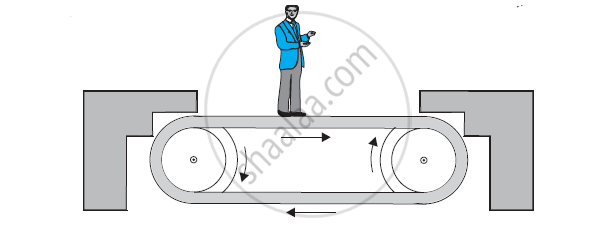
Figure shows a man standing stationary with respect to a horizontal conveyor belt that is accelerating with 1 m s–2. What is the net force on the man? If the coefficient of static friction between the man’s shoes and the belt is 0.2, up to what acceleration of the belt can the man continue to be stationary relative to the belt? (Mass of the man = 65 kg.)
A stream of water flowing horizontally with a speed of 15 m s–1 gushes out of a tube of cross-sectional area 10–2 m2, and hits a vertical wall nearby. What is the force exerted on the wall by the impact of water, assuming it does not rebound?
Name the physical quantity which is considered to be a measure of the quantity of motion of a body.
Explain why, it is easier to stop a tennis ball than a cricket ball moving with the same speed.
A 10 g bullet travelling at 200 m/s strikes and remains embedded in a 2 kg target which is originally at rest but free to move. At what speed does the target move off ?
State the law of conservation of momentum.
A heavy car A of mass 2000 kg travelling at 10 m/s has a head-on collision with a sports car B of mass 500 kg. If both cars stop dead on colliding, what was the velocity of car B ?
The rockets work on the principle of conservation of :
