Advertisements
Advertisements
प्रश्न
What is the change in momentum of a car weighing 1500 kg when its speed increases from 36 km/h to 72 km/h uniformly ?
Advertisements
उत्तर
We know that :
Momentum = mass × velocity
= m × v
Here, mass, m = 1500 kg
And, velocity, v = 36 km/h
= `36 xx 1000/3600`
= `36 xx 1000/3600`
= `36 xx 10/36`
= 10 m/s
Putting these values in the above formula, we get:
Initial Momentum = 1500 × 10 kg.m/s = 15000 kg.m/s
Also, we know that:
Momentum = mass × velocity
= m × v
Here, mass, m = 1500 kg
And, velocity, v = 72 km/h
= `72 xx 1000/3600`
= `72 xx 1000/3600`
= `72 xx 10/36`
= 20 m/s
Putting these values in the above formula, we get:
Final Momentum = 1500 × 20 kg.m/s = 30000 kg.m/s.
The change in momentum of a car weighing 1500 kg when its speed increases from 36 km/h to 72 km/h = 30000 kg.m/s − 15000 kg.m/s = 15000 kg.m/s.
APPEARS IN
संबंधित प्रश्न
From a rifle of mass 4 kg, a bullet of mass 50 g is fired with an initial velocity of 35 m s−1. Calculate the initial recoil velocity of the rifle.
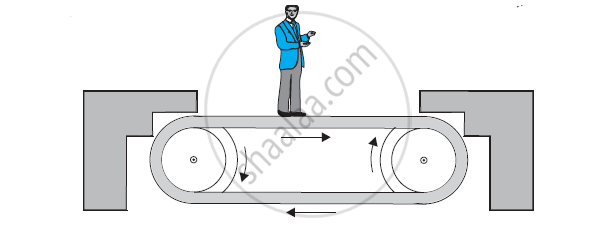
Figure shows a man standing stationary with respect to a horizontal conveyor belt that is accelerating with 1 m s–2. What is the net force on the man? If the coefficient of static friction between the man’s shoes and the belt is 0.2, up to what acceleration of the belt can the man continue to be stationary relative to the belt? (Mass of the man = 65 kg.)
A stream of water flowing horizontally with a speed of 15 m s–1 gushes out of a tube of cross-sectional area 10–2 m2, and hits a vertical wall nearby. What is the force exerted on the wall by the impact of water, assuming it does not rebound?
What is the momentum in kg.m/s of a 10 kg car travelling at (a) 5 m/s (b) 20 cm/s, and (c) 36 km/h ?
Which physical quantity corresponds to the rate of change of momentum ?
Explain why, a cricket player moves his hands backwards while catching a fast cricket ball.
A 150 g ball, travelling at 30 m/s, strikes the palm of a player’s hand and is stopped in 0.05 second. Find the force exerted by the ball on the hand.
A ball X of mass 1 kg travelling at 2 m/s has a head-on collision with an identical ball Y at rest. X stops and Y moves off. Calculate the velocity of Y after the collision.
A man wearing a bullet-proof vest stands still on roller skates. The total mass is 80 kg. A bullet of mass 20 grams is fired at 400 m/s. It is stopped by the vest and falls to the ground. What is then the velocity of the man?
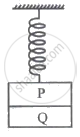
Two blocks P and Q of masses 0.3 kg and 0.4 kg, respectively, are stuck to each other by some weak glue as shown in the figure. They hang together at the end of a spring with a spring constant of k = 200 N/m. The block Q suddenly falls free due to the failure of glue, then the maximum kinetic energy of block P during subsequent motion will be ______ mJ.