Advertisements
Advertisements
प्रश्न
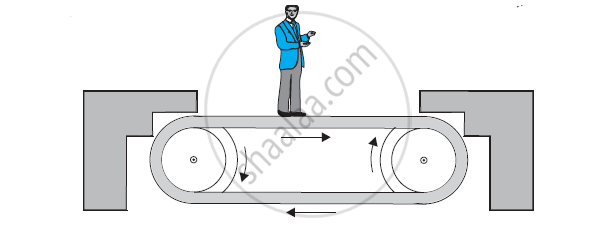
Figure shows a man standing stationary with respect to a horizontal conveyor belt that is accelerating with 1 m s–2. What is the net force on the man? If the coefficient of static friction between the man’s shoes and the belt is 0.2, up to what acceleration of the belt can the man continue to be stationary relative to the belt? (Mass of the man = 65 kg.)
Advertisements
उत्तर १
Mass of the man, m = 65 kg
Acceleration of the belt, a = 1 m/s2
Coefficient of static friction, μ = 0.2
The net force F, acting on the man is given by Newton’s second law of motion as:
`F_"net"` = ma = 65 × 1 = 65 N
The man will continue to be stationary with respect to the conveyor belt until the net force on the man is less than or equal to the frictional force fs, exerted by the belt, i.e.,
`F_"net"^' = f_s`
`ma^' = mu mg`
∴a' = 0.2 × 10 = 2 m/s2
Therefore, the maximum acceleration of the belt up to which the man can stand stationary is 2 m/s2.
उत्तर २
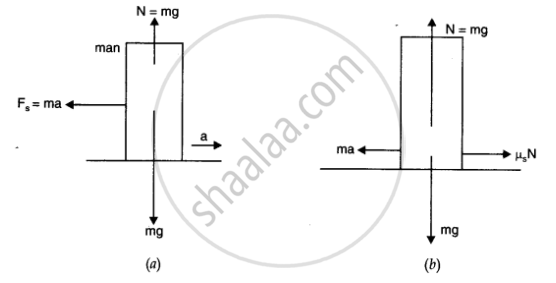
Here acceleration of conveyor belt a = 1 ms-2, μs= 0.2 and mass of man m = 65 kg. t As the man is in an accelerating frame, he experiences a pseudo force Fs= ma as shown in figure
Hence to maintain his equilibrium, he exerts a force F = – Fs = ma = 65 x 1 = 65 N in forward direction i.e., direction of motion of belt.
∴Net force acting on man = 65 N (forward)
As shown in fig. (b), the man can continue to be stationary with respect to belt, if force of friction
`mu_s N = mu_s mg = ma_"max"`
`a_"max" = mu_s g = 0.2 xx 10 = 2 m s^(-2)`
संबंधित प्रश्न
A hockey ball of mass 200 g travelling at 10 m s−1 is struck by a hockey stick so as to return it along its original path with a velocity at 5 m s−1. Calculate the change of momentum occurred in the motion of the hockey ball by the force applied by the hockey stick.
An object of mass 1 kg travelling in a straight line with a velocity of 10 ms−1 collides with, and sticks to, a stationary wooden block of mass 5 kg. Then they both move off together in the same straight line. Calculate the total momentum just before the impact and just after the impact. Also, calculate the velocity of the combined object.
A nucleus is at rest in the laboratory frame of reference. Show that if it disintegrates into two smaller nuclei the products must move in opposite directions.
Name the physical quantity which is considered to be a measure of the quantity of motion of a body.
Explain why, it is easier to stop a tennis ball than a cricket ball moving with the same speed.
Explain the meaning of the following equation : .
p = m x v
where symbols have their usual meanings.
Explain how, a karate player can break a pile of tiles with a single blow of his hand.
Calculate the momentum of a toy car of mass 200 g moving with a speed of 5 m/s.
Calculate the change in momentum of a body weighing 5 kg when its velocity decreases from 20 m/s to 0.20 m/s.
A plastic ball and a clay ball of equal masses, travelling in the same direction with equal speeds, strike against a vertical wall. From which ball does the wall receive a greater amount of momentum ?
A gun of mass 3 kg fires a bullet of mass 30 g. The bullet takes 0.003 s to move through the barrel of the gun and acquires a velocity of 100 m/s. Calculate:
- the velocity with which the gin recoils.
- the force exerted on gunman due to recoil of the gun
Explain why, a cricket player moves his hands backwards while catching a fast cricket ball.
An unloaded truck weighing 2000 kg has a maximum acceleration of 0.5 m/s2. What is the maximum acceleration when it is carrying a load of 2000 kg ?
Why are car seat-belts designed to stretch some what in a collision ?
Why would an aircraft be unable to fly on the moon ?
Explain why it is possible for a small animal to fall from a considerable height without any injury being caused when it reaches the ground.
A heavy car A of mass 2000 kg travelling at 10 m/s has a head-on collision with a sports car B of mass 500 kg. If both cars stop dead on colliding, what was the velocity of car B ?
A girl riding a bicycle along a straight road with a speed of 5 ms–1 throws a stone of mass 0.5 kg which has a speed of 15 ms–1 with respect to the ground along her direction of motion. The mass of the girl and bicycle is 50 kg. Does the speed of the bicycle change after the stone is thrown? What is the change in speed, if so?
A monkey of mass 20 kg rides on a 40 kg trolley moving with constant speed of 8 m/s along a horizontal track If the monkey jumps vertically to grab the overhanging branch of a tree, the speed of the trolley after the monkey has jumped off is ______.
