Advertisements
Advertisements
प्रश्न
A hockey ball of mass 200 g travelling at 10 m s−1 is struck by a hockey stick so as to return it along its original path with a velocity at 5 m s−1. Calculate the change of momentum occurred in the motion of the hockey ball by the force applied by the hockey stick.
Advertisements
उत्तर
Mass of ball (m) = 200 g = 0.2 kg
Initial velocity of ball (u1) = 10 ms-1
∴ The initial momentum of the ball = mu1
= 0.2 kg × 10 ms-1
= 2 N s
Final velocity of ball (u2) = - 5 ms-1
(The minimum sign denotes that the ball is moving in the opposite direction.)
∴ Final momentum of ball = mu2
= 0.2 kg × (- 5 ms-1)
= - 1 N s
∴ Change in momentum = Final momentum - Initial momentum
= - 1Ns - 2Ns
= - 3Ns
The Minus sign denotes that the change in momentum is opposite to the direction of the initial momentum of the ball.
संबंधित प्रश्न
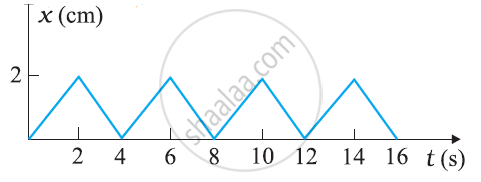
Figure shows the position-time graph of a body of mass 0.04 kg. Suggest a suitable physical context for this motion. What is the time between two consecutive impulses received by the body ? What is the magnitude of each impulse ?
A stream of water flowing horizontally with a speed of 15 m s–1 gushes out of a tube of cross-sectional area 10–2 m2, and hits a vertical wall nearby. What is the force exerted on the wall by the impact of water, assuming it does not rebound?
Explain the meaning of the following equation : .
p = m x v
where symbols have their usual meanings.
Calculate the momentum of a toy car of mass 200 g moving with a speed of 5 m/s.
What is the momentum in kg.m/s of a 10 kg car travelling at (a) 5 m/s (b) 20 cm/s, and (c) 36 km/h ?
Fill in the following blanks with suitable words :
In collisions and explosions, the total _____________ remains constant, provided that no external _____________ acts.
Discuss the conservation of momentum in each of the following cases :
(i) a rocket taking off from ground.
(ii) flying of a jet aeroplane.
The troops (soldiers) equipped to be dropped by parachutes from an aircraft are called paratroopers. Why do paratroopers roll on landing ?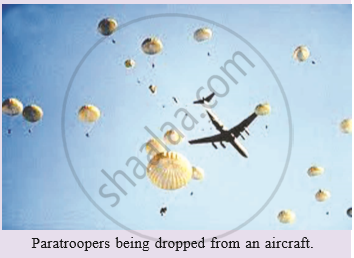
A girl of mass 50 kg jumps out of a rowing boat of mass 300 kg on to the bank, with a horizontal velocity of 3 m/s. With what velocity does the boat begin to move backwards ?
A heavy car A of mass 2000 kg travelling at 10 m/s has a head-on collision with a sports car B of mass 500 kg. If both cars stop dead on colliding, what was the velocity of car B ?
