Advertisements
Advertisements
प्रश्न
A girl riding a bicycle along a straight road with a speed of 5 ms–1 throws a stone of mass 0.5 kg which has a speed of 15 ms–1 with respect to the ground along her direction of motion. The mass of the girl and bicycle is 50 kg. Does the speed of the bicycle change after the stone is thrown? What is the change in speed, if so?
Advertisements
उत्तर
Given, the total mass of girl, bicycle and stone = m1 = (50 + 0.5) kg = 50.5 kg.
Velocity of bicycle u1 = 5 m/s, Mass of stone m2 = 0.5 kg
Velocity of stone u2 = 15 m/s, Mass of girl and bicycle m = 50 kg
Yes, the speed of the bicycle changes after the stone is thrown.
Let after throwing the stone the speed of bicycle is v ms.
According to the law of conservation of linear momentum,
m1u1 = m2u2 + mv
50.5 × 5 = 0.5 × 15 + 50 × v
252.5 – 7.5 = 50 v
or v = `245.0/50`
v = 4.9/m/s
Change in speed = 5 – 4.9 = 0.1 m/s.
APPEARS IN
संबंधित प्रश्न
From a rifle of mass 4 kg, a bullet of mass 50 g is fired with an initial velocity of 35 m s−1. Calculate the initial recoil velocity of the rifle.
Two objects of masses 100 g and 200 g are moving along the same line and direction with velocities of 2 m s−1 and 1 m s−1, respectively. They collide and after the collision, the first object moves at a velocity of 1.67 m s−1. Determine the velocity of the second object.
A nucleus is at rest in the laboratory frame of reference. Show that if it disintegrates into two smaller nuclei the products must move in opposite directions.
Two billiard balls, each of mass 0.05 kg, moving in opposite directions with speed 6 ms-1collide and rebound with the same speed. What is the impulse imparted to each ball due to the other?
Figure shows the position-time graph of a body of mass 0.04 kg. Suggest a suitable physical context for this motion. What is the time between two consecutive impulses received by the body ? What is the magnitude of each impulse ?
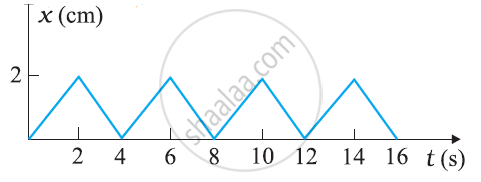
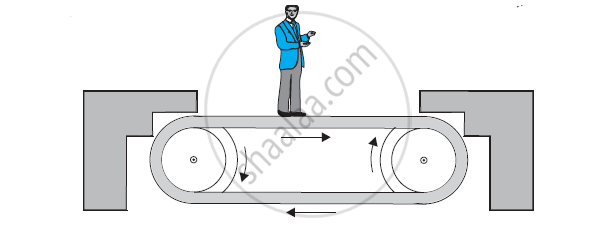
Figure shows a man standing stationary with respect to a horizontal conveyor belt that is accelerating with 1 m s–2. What is the net force on the man? If the coefficient of static friction between the man’s shoes and the belt is 0.2, up to what acceleration of the belt can the man continue to be stationary relative to the belt? (Mass of the man = 65 kg.)
A stream of water flowing horizontally with a speed of 15 m s–1 gushes out of a tube of cross-sectional area 10–2 m2, and hits a vertical wall nearby. What is the force exerted on the wall by the impact of water, assuming it does not rebound?
What is the total momentum of the bullet and the gun before firing ?
Explain the meaning of the following equation : .
p = m x v
where symbols have their usual meanings.
Calculate the momentum of a toy car of mass 200 g moving with a speed of 5 m/s.
What is the momentum in kg.m/s of a 10 kg car travelling at (a) 5 m/s (b) 20 cm/s, and (c) 36 km/h ?
Define momentum of a body. On what factors does the momentum of a body depend ?
Calculate the change in momentum of a body weighing 5 kg when its velocity decreases from 20 m/s to 0.20 m/s.
Fill in the following blanks with suitable words :
Momentum is a _____________ quantity. Its unit is _____________.
The velocity of a body of mass 10 kg increases from 4 m/s to 8 m/s when a force acts on it for 2 s.
(a) What is the momentum before the force acts ?
(b) What is the momentum after the force acts ?
(c) What is the gain in momentum per second ?
(d) What is the value of the force ?
State the law of conservation of momentum.
Why are car seat-belts designed to stretch some what in a collision ?
Explain why it is possible for a small animal to fall from a considerable height without any injury being caused when it reaches the ground.
A ball X of mass 1 kg travelling at 2 m/s has a head-on collision with an identical ball Y at rest. X stops and Y moves off. Calculate the velocity of Y after the collision.
Suppose a ball of mass m is thrown vertically upward with an initial speed v, its speed decreases continuously till it becomes zero. Thereafter, the ball begins to fall downward and attains the speed v again before striking the ground. It implies that the magnitude of the initial and final momentums of the ball are the same. Yet, it is not an example of conservation of momentum. Explain why?
