Advertisements
Advertisements
प्रश्न
What is the total momentum of the bullet and the gun before firing ?
Advertisements
उत्तर
The total momentum of the bullet and the gun before firing would be zero because velocities of both of them will be zero.
APPEARS IN
संबंधित प्रश्न
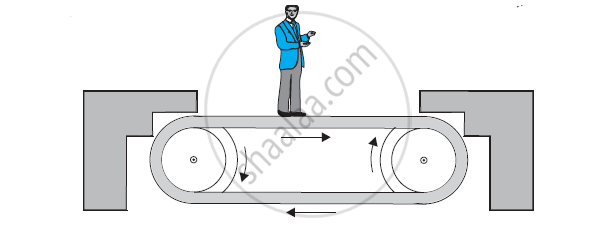
Figure shows a man standing stationary with respect to a horizontal conveyor belt that is accelerating with 1 m s–2. What is the net force on the man? If the coefficient of static friction between the man’s shoes and the belt is 0.2, up to what acceleration of the belt can the man continue to be stationary relative to the belt? (Mass of the man = 65 kg.)
Name the physical quantity whose unit is kg.m/s.
Explain how, a karate player can break a pile of tiles with a single blow of his hand.
What is the momentum in kg.m/s of a 10 kg car travelling at (a) 5 m/s (b) 20 cm/s, and (c) 36 km/h ?
Fill in the following blanks with suitable words :
In collisions and explosions, the total _____________ remains constant, provided that no external _____________ acts.
A gun of mass 3 kg fires a bullet of mass 30 g. The bullet takes 0.003 s to move through the barrel of the gun and acquires a velocity of 100 m/s. Calculate:
- the velocity with which the gin recoils.
- the force exerted on gunman due to recoil of the gun
State the law of conservation of momentum.
Why are car seat-belts designed to stretch some what in a collision ?
Explain why it is possible for a small animal to fall from a considerable height without any injury being caused when it reaches the ground.
The rockets work on the principle of conservation of :
