Advertisements
Advertisements
प्रश्न
Name the physical quantity whose unit is kg.m/s.
Advertisements
उत्तर
Momentum is the physical quantity whose unit is kg.m/s.
APPEARS IN
संबंधित प्रश्न
From a rifle of mass 4 kg, a bullet of mass 50 g is fired with an initial velocity of 35 m s−1. Calculate the initial recoil velocity of the rifle.
Explain how, a karate player can break a pile of tiles with a single blow of his hand.
What is the change in momentum of a car weighing 1500 kg when its speed increases from 36 km/h to 72 km/h uniformly ?
Calculate the change in momentum of a body weighing 5 kg when its velocity decreases from 20 m/s to 0.20 m/s.
A 10 g bullet travelling at 200 m/s strikes and remains embedded in a 2 kg target which is originally at rest but free to move. At what speed does the target move off ?
The troops (soldiers) equipped to be dropped by parachutes from an aircraft are called paratroopers. Why do paratroopers roll on landing ?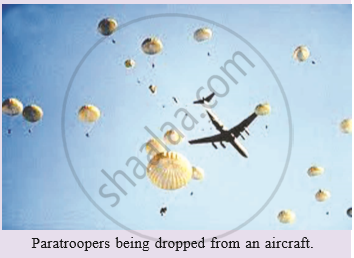
Explain why it is possible for a small animal to fall from a considerable height without any injury being caused when it reaches the ground.
A boy of mass 50 kg running at 5 m/s jumps on to a 20 kg trolley travelling in the same direction at 1.5 m/s. What is their common velocity ?
Suppose a ball of mass m is thrown vertically upward with an initial speed v, its speed decreases continuously till it becomes zero. Thereafter, the ball begins to fall downward and attains the speed v again before striking the ground. It implies that the magnitude of the initial and final momentums of the ball are the same. Yet, it is not an example of conservation of momentum. Explain why?
Two billiard balls A and B, each of mass 50 g and moving in opposite directions with speed of 5 ms–1 each, collide and rebound with the same speed. If the collision lasts for 10–3 s, which of the following statements are true?
- The impulse imparted to each ball is 0.25 kg ms–1 and the force on each ball is 250 N.
- The impulse imparted to each ball is 0.25 kg ms–1 and the force exerted on each ball is 25 × 10–5 N.
- The impulse imparted to each ball is 0.5 Ns.
- The impulse and the force on each ball are equal in magnitude and opposite in direction.
