Advertisements
Advertisements
प्रश्न
Two objects of masses 100 g and 200 g are moving along the same line and direction with velocities of 2 m s−1 and 1 m s−1, respectively. They collide and after the collision, the first object moves at a velocity of 1.67 m s−1. Determine the velocity of the second object.
Advertisements
उत्तर
Mass of one of the objects, m1 = 100 g = 0.1 kg
Mass of the other object, m2 = 200 g = 0.2 kg
Velocity of m1 before collision, v1 = 2 m/s
Velocity of m2 before collision, v2 = 1 m/s
Velocity of m1 after collision, v3 = 1.67 m/s
Velocity of m2 after collision = v4
According to the law of conservation of momentum:-
Total momentum before collision = Total momentum after collision
∴ m1v1 + m2v2 = m1v3 + m2v4
(0.1)2 + (0.2)1 = (0.1)1.67 + (0.2)v4
0.4 = 0.167 + 0.2v4
∴ v4 = 1.165 m/s
Hence, the velocity of the second object becomes 1.165 m/s after the collision.
संबंधित प्रश्न
Two objects, each of mass 1.5 kg are moving in the same straight line but in opposite directions. The velocity of each object is 2.5 m s−1 before the collision during which they stick together. What will be the velocity of the combined object after collision?
An object of mass 1 kg travelling in a straight line with a velocity of 10 ms−1 collides with, and sticks to, a stationary wooden block of mass 5 kg. Then they both move off together in the same straight line. Calculate the total momentum just before the impact and just after the impact. Also, calculate the velocity of the combined object.
A shell of mass 0.020 kg is fired by a gun of mass 100 kg. If the muzzle speed of the shell is 80 m s–1, what is the recoil speed of the gun?
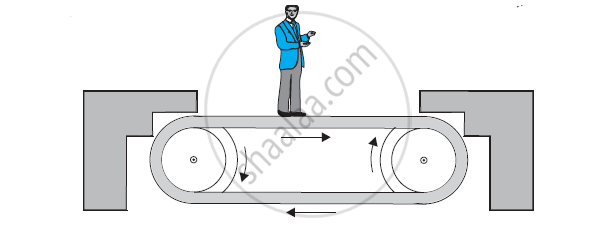
Figure shows a man standing stationary with respect to a horizontal conveyor belt that is accelerating with 1 m s–2. What is the net force on the man? If the coefficient of static friction between the man’s shoes and the belt is 0.2, up to what acceleration of the belt can the man continue to be stationary relative to the belt? (Mass of the man = 65 kg.)
Explain how, a karate player can break a pile of tiles with a single blow of his hand.
Define momentum of a body. On what factors does the momentum of a body depend ?
Name the law involved in the following situation :
the sum of products of masses and velocities of two moving bodies before and after their collision remains the same.
Explain why, a cricket player moves his hands backwards while catching a fast cricket ball.
Why would an aircraft be unable to fly on the moon ?
Two billiard balls A and B, each of mass 50 g and moving in opposite directions with speed of 5 ms–1 each, collide and rebound with the same speed. If the collision lasts for 10–3 s, which of the following statements are true?
- The impulse imparted to each ball is 0.25 kg ms–1 and the force on each ball is 250 N.
- The impulse imparted to each ball is 0.25 kg ms–1 and the force exerted on each ball is 25 × 10–5 N.
- The impulse imparted to each ball is 0.5 Ns.
- The impulse and the force on each ball are equal in magnitude and opposite in direction.
