Advertisements
Advertisements
प्रश्न
Calculate the momentum of a toy car of mass 200 g moving with a speed of 5 m/s.
Advertisements
उत्तर
We know that:
Momentum = mass × velocity
= m × v
Here, mass, m = 200 g
or m = 0.2 kg
And, velocity, v = 5 m/s
Putting these values in the above formula, we get:
Momentum = 0.2 × 5 kg.m/s = 1 kg.m/s.
APPEARS IN
संबंधित प्रश्न
From a rifle of mass 4 kg, a bullet of mass 50 g is fired with an initial velocity of 35 m s−1. Calculate the initial recoil velocity of the rifle.
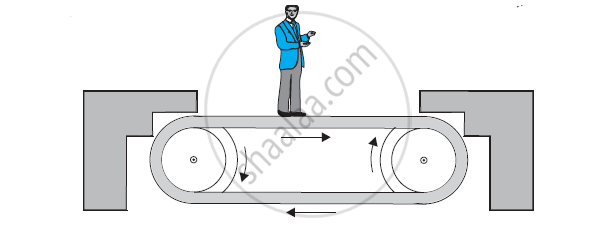
Figure shows a man standing stationary with respect to a horizontal conveyor belt that is accelerating with 1 m s–2. What is the net force on the man? If the coefficient of static friction between the man’s shoes and the belt is 0.2, up to what acceleration of the belt can the man continue to be stationary relative to the belt? (Mass of the man = 65 kg.)
state whether momentum is scalar or vector.
Explain the meaning of the following equation : .
p = m x v
where symbols have their usual meanings.
A man throws a ball weighing 500 g vertically upwards with a speed of 10 m/s.
- What will be its initial momentum ?
- What would be its momentum at the highest point of its flight ?
Fill in the following blanks with suitable words :
In collisions and explosions, the total _____________ remains constant, provided that no external _____________ acts.
Name the law involved in the following situation :
the sum of products of masses and velocities of two moving bodies before and after their collision remains the same.
Explain why, a cricket player moves his hands backwards while catching a fast cricket ball.
A boy of mass 50 kg running at 5 m/s jumps on to a 20 kg trolley travelling in the same direction at 1.5 m/s. What is their common velocity ?
A man wearing a bullet-proof vest stands still on roller skates. The total mass is 80 kg. A bullet of mass 20 grams is fired at 400 m/s. It is stopped by the vest and falls to the ground. What is then the velocity of the man?
