Advertisements
Advertisements
प्रश्न
Calculate the momentum of a toy car of mass 200 g moving with a speed of 5 m/s.
Advertisements
उत्तर
We know that:
Momentum = mass × velocity
= m × v
Here, mass, m = 200 g
or m = 0.2 kg
And, velocity, v = 5 m/s
Putting these values in the above formula, we get:
Momentum = 0.2 × 5 kg.m/s = 1 kg.m/s.
APPEARS IN
संबंधित प्रश्न
Two objects, each of mass 1.5 kg are moving in the same straight line but in opposite directions. The velocity of each object is 2.5 m s−1 before the collision during which they stick together. What will be the velocity of the combined object after collision?
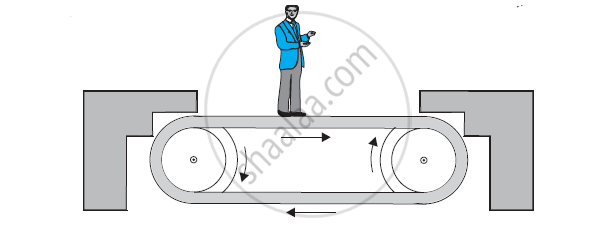
Figure shows a man standing stationary with respect to a horizontal conveyor belt that is accelerating with 1 m s–2. What is the net force on the man? If the coefficient of static friction between the man’s shoes and the belt is 0.2, up to what acceleration of the belt can the man continue to be stationary relative to the belt? (Mass of the man = 65 kg.)
Explain how, a karate player can break a pile of tiles with a single blow of his hand.
State the relation between the momentum of a body and the force acting on it.
A 10 g bullet travelling at 200 m/s strikes and remains embedded in a 2 kg target which is originally at rest but free to move. At what speed does the target move off ?
A gun of mass 3 kg fires a bullet of mass 30 g. The bullet takes 0.003 s to move through the barrel of the gun and acquires a velocity of 100 m/s. Calculate:
- the velocity with which the gin recoils.
- the force exerted on gunman due to recoil of the gun
Explain why, a cricket player moves his hands backwards while catching a fast cricket ball.
The troops (soldiers) equipped to be dropped by parachutes from an aircraft are called paratroopers. Why do paratroopers roll on landing ?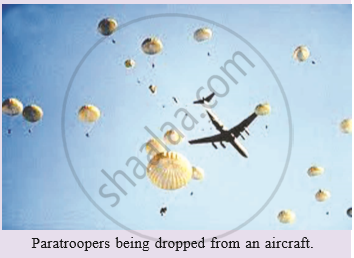
Explain why it is possible for a small animal to fall from a considerable height without any injury being caused when it reaches the ground.
A truck of mass 500 kg moving at 4 m/s collides with another truck of mass 1500 kg moving in the same direction at 2 m/s. What is their common velocity just after the collision if they move off together ?
