Advertisements
Advertisements
प्रश्न
A gun of mass 3 kg fires a bullet of mass 30 g. The bullet takes 0.003 s to move through the barrel of the gun and acquires a velocity of 100 m/s. Calculate:
- the velocity with which the gin recoils.
- the force exerted on gunman due to recoil of the gun
Advertisements
उत्तर
Given Data:
- Mass of the gun (M) = 3 kg
- Mass of the bullet (m) = 30 g = 0.03 kg
- Velocity of the bullet (v) = 100 m/s
- Time taken by the bullet to move through the barrel (t) = 0.003 s
1. Velocity with which the gun recoils:
From the law of conservation of momentum:
Total initial momentum = Total final momentum
Initially, both the gun and bullet are at rest, so total momentum is zero. After firing:
M⋅V + m⋅v = 0
Where V is the recoil velocity of the gun. Rearrange the equation to find V:
`V = -(m.v)/M`
`V = - (0.03 xx 100)/3`
−1 m/s
2. Force exerted on the gunman due to recoil:
The force exerted on the gunman can be calculated using Newton's Second Law:
F = M × a
`a = (ΔV)/t`
Here, ΔV = 1 m/s and t = 0.003 s
`a = 1/0.003` = 333.33 m/s2
F = 3 × 333.33 = 1000 N
Final Answers:
- Recoil velocity of the gun = 1 m/s
- Force exerted on the gunman = 1000 N
APPEARS IN
संबंधित प्रश्न
From a rifle of mass 4 kg, a bullet of mass 50 g is fired with an initial velocity of 35 m s−1. Calculate the initial recoil velocity of the rifle.
Two objects of masses 100 g and 200 g are moving along the same line and direction with velocities of 2 m s−1 and 1 m s−1, respectively. They collide and after the collision, the first object moves at a velocity of 1.67 m s−1. Determine the velocity of the second object.
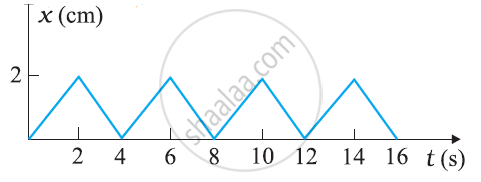
Figure shows the position-time graph of a body of mass 0.04 kg. Suggest a suitable physical context for this motion. What is the time between two consecutive impulses received by the body ? What is the magnitude of each impulse ?
Which physical quantity corresponds to the rate of change of momentum ?
Fill in the following blanks with suitable words :
In collisions and explosions, the total _____________ remains constant, provided that no external _____________ acts.
A ball X of mass 1 kg travelling at 2 m/s has a head-on collision with an identical ball Y at rest. X stops and Y moves off. Calculate the velocity of Y after the collision.
A man wearing a bullet-proof vest stands still on roller skates. The total mass is 80 kg. A bullet of mass 20 grams is fired at 400 m/s. It is stopped by the vest and falls to the ground. What is then the velocity of the man?
Suppose a ball of mass m is thrown vertically upward with an initial speed v, its speed decreases continuously till it becomes zero. Thereafter, the ball begins to fall downward and attains the speed v again before striking the ground. It implies that the magnitude of the initial and final momentums of the ball are the same. Yet, it is not an example of conservation of momentum. Explain why?
A 100 kg gun fires a ball of 1 kg horizontally from a cliff of height 500 m. It falls on the ground at a distance of 400 m from the bottom of the cliff. Find the recoil velocity of the gun. (acceleration due to gravity = 10 ms–2)
Two blocks P and Q of masses 0.3 kg and 0.4 kg, respectively, are stuck to each other by some weak glue as shown in the figure. They hang together at the end of a spring with a spring constant of k = 200 N/m. The block Q suddenly falls free due to the failure of glue, then the maximum kinetic energy of block P during subsequent motion will be ______ mJ.