Advertisements
Advertisements
Question
A gun of mass 3 kg fires a bullet of mass 30 g. The bullet takes 0.003 s to move through the barrel of the gun and acquires a velocity of 100 m/s. Calculate:
- the velocity with which the gin recoils.
- the force exerted on gunman due to recoil of the gun
Advertisements
Solution
Given Data:
- Mass of the gun (M) = 3 kg
- Mass of the bullet (m) = 30 g = 0.03 kg
- Velocity of the bullet (v) = 100 m/s
- Time taken by the bullet to move through the barrel (t) = 0.003 s
1. Velocity with which the gun recoils:
From the law of conservation of momentum:
Total initial momentum = Total final momentum
Initially, both the gun and bullet are at rest, so total momentum is zero. After firing:
M⋅V + m⋅v = 0
Where V is the recoil velocity of the gun. Rearrange the equation to find V:
`V = -(m.v)/M`
`V = - (0.03 xx 100)/3`
−1 m/s
2. Force exerted on the gunman due to recoil:
The force exerted on the gunman can be calculated using Newton's Second Law:
F = M × a
`a = (ΔV)/t`
Here, ΔV = 1 m/s and t = 0.003 s
`a = 1/0.003` = 333.33 m/s2
F = 3 × 333.33 = 1000 N
Final Answers:
- Recoil velocity of the gun = 1 m/s
- Force exerted on the gunman = 1000 N
APPEARS IN
RELATED QUESTIONS
Two objects of masses 100 g and 200 g are moving along the same line and direction with velocities of 2 m s−1 and 1 m s−1, respectively. They collide and after the collision, the first object moves at a velocity of 1.67 m s−1. Determine the velocity of the second object.
Two objects, each of mass 1.5 kg are moving in the same straight line but in opposite directions. The velocity of each object is 2.5 m s−1 before the collision during which they stick together. What will be the velocity of the combined object after collision?
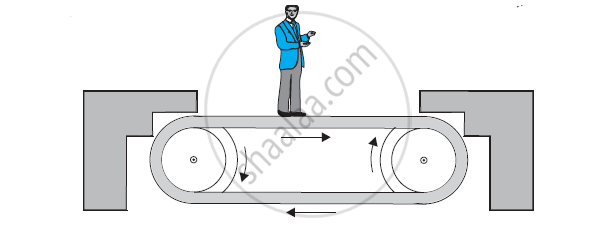
Figure shows a man standing stationary with respect to a horizontal conveyor belt that is accelerating with 1 m s–2. What is the net force on the man? If the coefficient of static friction between the man’s shoes and the belt is 0.2, up to what acceleration of the belt can the man continue to be stationary relative to the belt? (Mass of the man = 65 kg.)
state whether momentum is scalar or vector.
Calculate the momentum of a toy car of mass 200 g moving with a speed of 5 m/s.
Name the principle on which a rocket works.
A 10 g bullet travelling at 200 m/s strikes and remains embedded in a 2 kg target which is originally at rest but free to move. At what speed does the target move off ?
Explain why, a cricket player moves his hands backwards while catching a fast cricket ball.
State the law of conservation of momentum.
A man wearing a bullet-proof vest stands still on roller skates. The total mass is 80 kg. A bullet of mass 20 grams is fired at 400 m/s. It is stopped by the vest and falls to the ground. What is then the velocity of the man?
