Advertisements
Advertisements
प्रश्न
Define momentum of a body. On what factors does the momentum of a body depend ?
Advertisements
उत्तर
The quantity of motion of a body which is equal to the product of the mass and velocity of the body is known as momentum of body. It is a vector quantity and is expressed in kg.m/s.
The momentum of a body is defined as the product of its mass and velocity.
Thus, momentum = mass × velocity
p = m × v
The momentum of a body depends on two factors i.e., mass and velocity of the body.
APPEARS IN
संबंधित प्रश्न
A hockey ball of mass 200 g travelling at 10 m s−1 is struck by a hockey stick so as to return it along its original path with a velocity at 5 m s−1. Calculate the change of momentum occurred in the motion of the hockey ball by the force applied by the hockey stick.
A shell of mass 0.020 kg is fired by a gun of mass 100 kg. If the muzzle speed of the shell is 80 m s–1, what is the recoil speed of the gun?
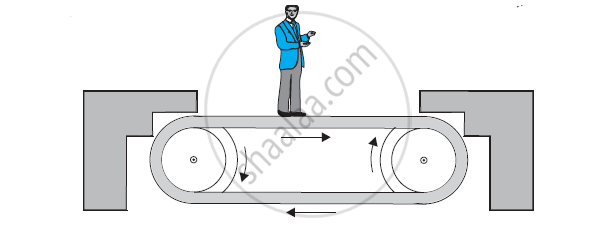
Figure shows a man standing stationary with respect to a horizontal conveyor belt that is accelerating with 1 m s–2. What is the net force on the man? If the coefficient of static friction between the man’s shoes and the belt is 0.2, up to what acceleration of the belt can the man continue to be stationary relative to the belt? (Mass of the man = 65 kg.)
state whether momentum is scalar or vector.
Explain how, a karate player can break a pile of tiles with a single blow of his hand.
Which physical principle is involved in the working of a jet aeroplane ?
A gun of mass 3 kg fires a bullet of mass 30 g. The bullet takes 0.003 s to move through the barrel of the gun and acquires a velocity of 100 m/s. Calculate:
- the velocity with which the gin recoils.
- the force exerted on gunman due to recoil of the gun
A truck of mass 500 kg moving at 4 m/s collides with another truck of mass 1500 kg moving in the same direction at 2 m/s. What is their common velocity just after the collision if they move off together ?
The rockets work on the principle of conservation of :
A monkey of mass 20 kg rides on a 40 kg trolley moving with constant speed of 8 m/s along a horizontal track If the monkey jumps vertically to grab the overhanging branch of a tree, the speed of the trolley after the monkey has jumped off is ______.
