Advertisements
Advertisements
प्रश्न
Calculate the change in momentum of a body weighing 5 kg when its velocity decreases from 20 m/s to 0.20 m/s.
Advertisements
उत्तर
For example,
Given that:
mass, m = 5 kg
velocity, v1 = 20 m/s
Therefore, momentum of a body moving with velocity v1, p1 = m × v1
= 5 × 20 = 100 kg.m/s
Now,
mass, m = 5 kg
velocity, v2 = 0.20 m/s
Therefore, momentum of a body moving with velocity v1, p2 = m × v1
= 5 × 0.20 = 1 kg.m/s
Change in the momentum of a body = p1 − p2
= 100 − 1
= 99 kg.m/s
APPEARS IN
संबंधित प्रश्न
A nucleus is at rest in the laboratory frame of reference. Show that if it disintegrates into two smaller nuclei the products must move in opposite directions.
state whether momentum is scalar or vector.
Explain how, a karate player can break a pile of tiles with a single blow of his hand.
Calculate the momentum of a toy car of mass 200 g moving with a speed of 5 m/s.
Which physical quantity corresponds to the rate of change of momentum ?
A 10 g bullet travelling at 200 m/s strikes and remains embedded in a 2 kg target which is originally at rest but free to move. At what speed does the target move off ?
The troops (soldiers) equipped to be dropped by parachutes from an aircraft are called paratroopers. Why do paratroopers roll on landing ?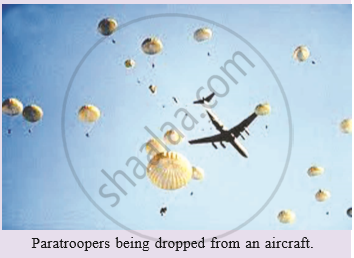
A boy of mass 50 kg running at 5 m/s jumps on to a 20 kg trolley travelling in the same direction at 1.5 m/s. What is their common velocity ?
A girl of mass 50 kg jumps out of a rowing boat of mass 300 kg on to the bank, with a horizontal velocity of 3 m/s. With what velocity does the boat begin to move backwards ?
Suppose a ball of mass m is thrown vertically upward with an initial speed v, its speed decreases continuously till it becomes zero. Thereafter, the ball begins to fall downward and attains the speed v again before striking the ground. It implies that the magnitude of the initial and final momentums of the ball are the same. Yet, it is not an example of conservation of momentum. Explain why?
