Advertisements
Advertisements
प्रश्न
A shell of mass 0.020 kg is fired by a gun of mass 100 kg. If the muzzle speed of the shell is 80 m s–1, what is the recoil speed of the gun?
Advertisements
उत्तर
Mass of the gun, m2 = 100 kg
Mass of the shell, m1 = 0.020 kg
initial velocities of both the shell and the gun are zero u1 = u2 = 0
After firing, the speed of the shell, v1 = 80 m s-1
Let v2 represent the recoil velocity of the gun. Following the principle of conservation of momentum,
m1v1 + m2v2 = m1u2 + m2u2
0.02 x 80 + 100v2 = 0.02 x 0 + 100 x 0
`v_2 = - 0.02xx80/100 = -0.016 "ms"^(-1)`
APPEARS IN
संबंधित प्रश्न
A nucleus is at rest in the laboratory frame of reference. Show that if it disintegrates into two smaller nuclei the products must move in opposite directions.
Two billiard balls, each of mass 0.05 kg, moving in opposite directions with speed 6 ms-1collide and rebound with the same speed. What is the impulse imparted to each ball due to the other?
Name the physical quantity which is considered to be a measure of the quantity of motion of a body.
state whether momentum is scalar or vector.
Explain why, it is easier to stop a tennis ball than a cricket ball moving with the same speed.
Calculate the momentum of a toy car of mass 200 g moving with a speed of 5 m/s.
What is the change in momentum of a car weighing 1500 kg when its speed increases from 36 km/h to 72 km/h uniformly ?
Define momentum of a body. On what factors does the momentum of a body depend ?
Calculate the change in momentum of a body weighing 5 kg when its velocity decreases from 20 m/s to 0.20 m/s.
Fill in the following blanks with suitable words :
In collisions and explosions, the total _____________ remains constant, provided that no external _____________ acts.
A body of mass 2 kg is at rest. What should be the magnitude of force which will make the body move with a speed of 30 m/s at the end of 1 s ?
A boy of mass 50 kg running at 5 m/s jumps on to a 20 kg trolley travelling in the same direction at 1.5 m/s. What is their common velocity ?
A ball X of mass 1 kg travelling at 2 m/s has a head-on collision with an identical ball Y at rest. X stops and Y moves off. Calculate the velocity of Y after the collision.
A heavy car A of mass 2000 kg travelling at 10 m/s has a head-on collision with a sports car B of mass 500 kg. If both cars stop dead on colliding, what was the velocity of car B ?
A man wearing a bullet-proof vest stands still on roller skates. The total mass is 80 kg. A bullet of mass 20 grams is fired at 400 m/s. It is stopped by the vest and falls to the ground. What is then the velocity of the man?
The rockets work on the principle of conservation of :
A 100 kg gun fires a ball of 1 kg horizontally from a cliff of height 500 m. It falls on the ground at a distance of 400 m from the bottom of the cliff. Find the recoil velocity of the gun. (acceleration due to gravity = 10 ms–2)
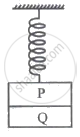
Two blocks P and Q of masses 0.3 kg and 0.4 kg, respectively, are stuck to each other by some weak glue as shown in the figure. They hang together at the end of a spring with a spring constant of k = 200 N/m. The block Q suddenly falls free due to the failure of glue, then the maximum kinetic energy of block P during subsequent motion will be ______ mJ.