Advertisements
Advertisements
Question
A shell of mass 0.020 kg is fired by a gun of mass 100 kg. If the muzzle speed of the shell is 80 m s–1, what is the recoil speed of the gun?
Advertisements
Solution
Mass of the gun, m2 = 100 kg
Mass of the shell, m1 = 0.020 kg
initial velocities of both the shell and the gun are zero u1 = u2 = 0
After firing, the speed of the shell, v1 = 80 m s-1
Let v2 represent the recoil velocity of the gun. Following the principle of conservation of momentum,
m1v1 + m2v2 = m1u2 + m2u2
0.02 x 80 + 100v2 = 0.02 x 0 + 100 x 0
`v_2 = - 0.02xx80/100 = -0.016 "ms"^(-1)`
APPEARS IN
RELATED QUESTIONS
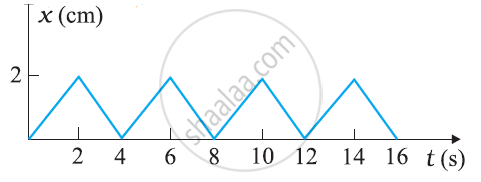
Figure shows the position-time graph of a body of mass 0.04 kg. Suggest a suitable physical context for this motion. What is the time between two consecutive impulses received by the body ? What is the magnitude of each impulse ?
Name the physical quantity which is considered to be a measure of the quantity of motion of a body.
Explain why, it is easier to stop a tennis ball than a cricket ball moving with the same speed.
Explain the meaning of the following equation : .
p = m x v
where symbols have their usual meanings.
Explain how, a karate player can break a pile of tiles with a single blow of his hand.
Define momentum of a body. On what factors does the momentum of a body depend ?
A plastic ball and a clay ball of equal masses, travelling in the same direction with equal speeds, strike against a vertical wall. From which ball does the wall receive a greater amount of momentum ?
Which physical principle is involved in the working of a jet aeroplane ?
A 10 g bullet travelling at 200 m/s strikes and remains embedded in a 2 kg target which is originally at rest but free to move. At what speed does the target move off ?
A gun of mass 3 kg fires a bullet of mass 30 g. The bullet takes 0.003 s to move through the barrel of the gun and acquires a velocity of 100 m/s. Calculate:
- the velocity with which the gin recoils.
- the force exerted on gunman due to recoil of the gun
A 150 g ball, travelling at 30 m/s, strikes the palm of a player’s hand and is stopped in 0.05 second. Find the force exerted by the ball on the hand.
An unloaded truck weighing 2000 kg has a maximum acceleration of 0.5 m/s2. What is the maximum acceleration when it is carrying a load of 2000 kg ?
Why are car seat-belts designed to stretch some what in a collision ?
A boy of mass 50 kg running at 5 m/s jumps on to a 20 kg trolley travelling in the same direction at 1.5 m/s. What is their common velocity ?
A ball X of mass 1 kg travelling at 2 m/s has a head-on collision with an identical ball Y at rest. X stops and Y moves off. Calculate the velocity of Y after the collision.
A heavy car A of mass 2000 kg travelling at 10 m/s has a head-on collision with a sports car B of mass 500 kg. If both cars stop dead on colliding, what was the velocity of car B ?
The rockets work on the principle of conservation of :
A monkey of mass 20 kg rides on a 40 kg trolley moving with constant speed of 8 m/s along a horizontal track If the monkey jumps vertically to grab the overhanging branch of a tree, the speed of the trolley after the monkey has jumped off is ______.
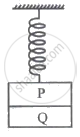
Two blocks P and Q of masses 0.3 kg and 0.4 kg, respectively, are stuck to each other by some weak glue as shown in the figure. They hang together at the end of a spring with a spring constant of k = 200 N/m. The block Q suddenly falls free due to the failure of glue, then the maximum kinetic energy of block P during subsequent motion will be ______ mJ.