Advertisements
Advertisements
Question
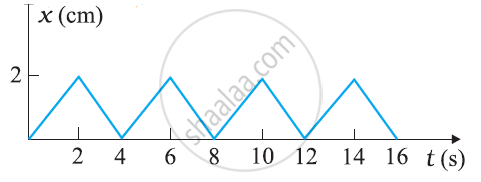
Figure shows the position-time graph of a body of mass 0.04 kg. Suggest a suitable physical context for this motion. What is the time between two consecutive impulses received by the body ? What is the magnitude of each impulse ?
Advertisements
Solution 1
A ball rebounding between two walls located between at x = 0 and x = 2 cm; after every 2 s, the ball receives an impulse of magnitude 0.08 × 10⁻² kg m/s from the walls
The given graph shows that a body changes its direction of motion after every 2 s. Physically, this situation can be visualized as a ball rebounding to and fro between two stationary walls situated between positions x = 0 and x = 2 cm. Since the slope of the x-t graph reverses after every 2 s, the ball collides with a wall after every 2 s.
Therefore, ball receives an impulse after every 2 s.
Mass of the ball, m = 0.04 kg
The slope of the graph gives the velocity of the ball. Using the graph, we can calculate initial velocity (u) as:
`u = ((2-0)xx10^2)/(2-0) = 10^(-2) "m/s"`
Velocity of the ball before collision, u = 10–2 m/s
Velocity of the ball after collision, v = –10–2 m/s
(Here, the negative sign arises as the ball reverses its direction of motion.)
Magnitude of impulse = Change in momentum
=|mv - mu|
=|0.04 (v -u)|
=|`0.04(-10^(-2)- 10^(-2))`|
= 0.08 × 10⁻² kg m/s
Solution 2
This graph can be of a ball rebounding between two walls situated at position 0 cm and 2 cm. The ball is rebounding from one wall to another, time and again every 2 s with uniform velocity.
Impulse, Here velocity = `("displacement")/"time" = 2/(100xx2) = 0.01 ms^(-2)`
Initial momentum = mu = `0.04 xx 0.01 = 4 xx 10^(-4) "kg ms"^(-1)`
Final momentum = mv = `0.04 x (-0.01) = -4 xx 10^(-4) "kg ms"^(-1)`
Magnitude of impulse = Change in momentum
=`(4xx 10^(-4)) -(-4xx10^(-4)) = 8 xx 10^(-4) kg ms^(-1)`
Time between two consecutive impulses is 2 s.i.e the ball receive an impulse every 2 s
RELATED QUESTIONS
Two objects of masses 100 g and 200 g are moving along the same line and direction with velocities of 2 m s−1 and 1 m s−1, respectively. They collide and after the collision, the first object moves at a velocity of 1.67 m s−1. Determine the velocity of the second object.
An object of mass 1 kg travelling in a straight line with a velocity of 10 ms−1 collides with, and sticks to, a stationary wooden block of mass 5 kg. Then they both move off together in the same straight line. Calculate the total momentum just before the impact and just after the impact. Also, calculate the velocity of the combined object.
Name the physical quantity which is considered to be a measure of the quantity of motion of a body.
What is the SI unit of momentum ?
What is the total momentum of the bullet and the gun before firing ?
Name the physical quantity whose unit is kg.m/s.
What is the change in momentum of a car weighing 1500 kg when its speed increases from 36 km/h to 72 km/h uniformly ?
What is the momentum in kg.m/s of a 10 kg car travelling at (a) 5 m/s (b) 20 cm/s, and (c) 36 km/h ?
State the relation between the momentum of a body and the force acting on it.
Name the principle on which a rocket works.
Fill in the following blanks with suitable words :
In collisions and explosions, the total _____________ remains constant, provided that no external _____________ acts.
Why are car seat-belts designed to stretch some what in a collision ?
Why would an aircraft be unable to fly on the moon ?
A girl of mass 50 kg jumps out of a rowing boat of mass 300 kg on to the bank, with a horizontal velocity of 3 m/s. With what velocity does the boat begin to move backwards ?
A heavy car A of mass 2000 kg travelling at 10 m/s has a head-on collision with a sports car B of mass 500 kg. If both cars stop dead on colliding, what was the velocity of car B ?
A man wearing a bullet-proof vest stands still on roller skates. The total mass is 80 kg. A bullet of mass 20 grams is fired at 400 m/s. It is stopped by the vest and falls to the ground. What is then the velocity of the man?
The rockets work on the principle of conservation of :
Two blocks P and Q of masses 0.3 kg and 0.4 kg, respectively, are stuck to each other by some weak glue as shown in the figure. They hang together at the end of a spring with a spring constant of k = 200 N/m. The block Q suddenly falls free due to the failure of glue, then the maximum kinetic energy of block P during subsequent motion will be ______ mJ.