Advertisements
Advertisements
Question
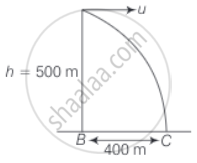
A 100 kg gun fires a ball of 1 kg horizontally from a cliff of height 500 m. It falls on the ground at a distance of 400 m from the bottom of the cliff. Find the recoil velocity of the gun. (acceleration due to gravity = 10 ms–2)
Advertisements
Solution
Given, the mass of the gun (m1) = 100
Mass of the ball (m2) = 1 kg
Height of the cliff = 500 m
Horizontal distance travelled by the ball (x) = 400 m
From `h = 1/2 "gt"^2` .....(∵ Initial velocity in the downward direction is zero)
`500 = 1/2 xx 10 t^2`
`t = sqrt(100)` = 10 s
From `x = ut, u = x/t = 400/10` = 40 m/s
It v is the recoil velocity of gun, then according to the principle of conservation of linear momentum,
m1v = m2u
v = `(m_2u)/m_1 = 1/100 xx 40` = 0.4 m/s
APPEARS IN
RELATED QUESTIONS
An object of mass 1 kg travelling in a straight line with a velocity of 10 ms−1 collides with, and sticks to, a stationary wooden block of mass 5 kg. Then they both move off together in the same straight line. Calculate the total momentum just before the impact and just after the impact. Also, calculate the velocity of the combined object.
A stream of water flowing horizontally with a speed of 15 m s–1 gushes out of a tube of cross-sectional area 10–2 m2, and hits a vertical wall nearby. What is the force exerted on the wall by the impact of water, assuming it does not rebound?
state whether momentum is scalar or vector.
Explain how, a karate player can break a pile of tiles with a single blow of his hand.
What is the momentum in kg.m/s of a 10 kg car travelling at (a) 5 m/s (b) 20 cm/s, and (c) 36 km/h ?
Define momentum of a body. On what factors does the momentum of a body depend ?
Calculate the change in momentum of a body weighing 5 kg when its velocity decreases from 20 m/s to 0.20 m/s.
A man throws a ball weighing 500 g vertically upwards with a speed of 10 m/s.
- What will be its initial momentum ?
- What would be its momentum at the highest point of its flight ?
State the relation between the momentum of a body and the force acting on it.
Name the principle on which a rocket works.
Name the law involved in the following situation :
the sum of products of masses and velocities of two moving bodies before and after their collision remains the same.
An unloaded truck weighing 2000 kg has a maximum acceleration of 0.5 m/s2. What is the maximum acceleration when it is carrying a load of 2000 kg ?
A boy of mass 50 kg running at 5 m/s jumps on to a 20 kg trolley travelling in the same direction at 1.5 m/s. What is their common velocity ?
A truck of mass 500 kg moving at 4 m/s collides with another truck of mass 1500 kg moving in the same direction at 2 m/s. What is their common velocity just after the collision if they move off together ?
A ball X of mass 1 kg travelling at 2 m/s has a head-on collision with an identical ball Y at rest. X stops and Y moves off. Calculate the velocity of Y after the collision.
A heavy car A of mass 2000 kg travelling at 10 m/s has a head-on collision with a sports car B of mass 500 kg. If both cars stop dead on colliding, what was the velocity of car B ?
A monkey of mass 20 kg rides on a 40 kg trolley moving with constant speed of 8 m/s along a horizontal track If the monkey jumps vertically to grab the overhanging branch of a tree, the speed of the trolley after the monkey has jumped off is ______.
Two blocks P and Q of masses 0.3 kg and 0.4 kg, respectively, are stuck to each other by some weak glue as shown in the figure. They hang together at the end of a spring with a spring constant of k = 200 N/m. The block Q suddenly falls free due to the failure of glue, then the maximum kinetic energy of block P during subsequent motion will be ______ mJ.