Advertisements
Advertisements
Question
A man throws a ball weighing 500 g vertically upwards with a speed of 10 m/s.
- What will be its initial momentum ?
- What would be its momentum at the highest point of its flight ?
Advertisements
Solution
(i) We know that:
Momentum = mass × velocity
= m × v
Here, mass, m = 500 g
We can convert grams (g) to kilograms (kg). A kilogram has 1000 grams.
m = 500 / 1000
m = 0.5 kg
Also, velocity, v =10 m/s
Putting these values in the above formula, we get:
Momentum = 0.5 × 10 = 5 kg.m/s
(ii) Its momentum at the highest point of its flight would be zero. At the maximum height the velocity of the ball is zero.
APPEARS IN
RELATED QUESTIONS
Akhtar, Kiran and Rahul were riding in a motorcar that was moving with a high velocity on an expressway when an insect hit the windshield and got stuck on the windscreen. Akhtar and Kiran started pondering over the situation. Kiran suggested that the insect suffered a greater change in momentum as compared to the change in momentum of the motorcar (because the change in the velocity of the insect was much more than that of the motorcar). Akhtar said that since the motorcar was moving with a larger velocity, it exerted a larger force on the insect. And as a result the insect died. Rahul while putting an entirely new explanation said that both the motorcar and the insect experienced the same force and a change in their momentum. Comment on these suggestions.
A shell of mass 0.020 kg is fired by a gun of mass 100 kg. If the muzzle speed of the shell is 80 m s–1, what is the recoil speed of the gun?
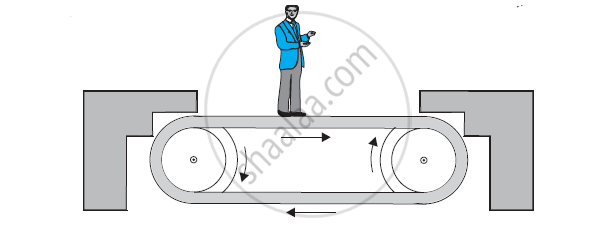
Figure shows a man standing stationary with respect to a horizontal conveyor belt that is accelerating with 1 m s–2. What is the net force on the man? If the coefficient of static friction between the man’s shoes and the belt is 0.2, up to what acceleration of the belt can the man continue to be stationary relative to the belt? (Mass of the man = 65 kg.)
What is the SI unit of momentum ?
state whether momentum is scalar or vector.
Fill in the following blanks with suitable words :
Momentum is a _____________ quantity. Its unit is _____________.
A 10 g bullet travelling at 200 m/s strikes and remains embedded in a 2 kg target which is originally at rest but free to move. At what speed does the target move off ?
A ball X of mass 1 kg travelling at 2 m/s has a head-on collision with an identical ball Y at rest. X stops and Y moves off. Calculate the velocity of Y after the collision.
A heavy car A of mass 2000 kg travelling at 10 m/s has a head-on collision with a sports car B of mass 500 kg. If both cars stop dead on colliding, what was the velocity of car B ?
The rockets work on the principle of conservation of :
