Advertisements
Advertisements
प्रश्न
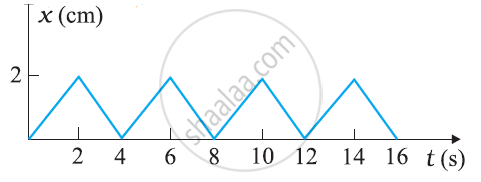
Figure shows the position-time graph of a body of mass 0.04 kg. Suggest a suitable physical context for this motion. What is the time between two consecutive impulses received by the body ? What is the magnitude of each impulse ?
Advertisements
उत्तर १
A ball rebounding between two walls located between at x = 0 and x = 2 cm; after every 2 s, the ball receives an impulse of magnitude 0.08 × 10⁻² kg m/s from the walls
The given graph shows that a body changes its direction of motion after every 2 s. Physically, this situation can be visualized as a ball rebounding to and fro between two stationary walls situated between positions x = 0 and x = 2 cm. Since the slope of the x-t graph reverses after every 2 s, the ball collides with a wall after every 2 s.
Therefore, ball receives an impulse after every 2 s.
Mass of the ball, m = 0.04 kg
The slope of the graph gives the velocity of the ball. Using the graph, we can calculate initial velocity (u) as:
`u = ((2-0)xx10^2)/(2-0) = 10^(-2) "m/s"`
Velocity of the ball before collision, u = 10–2 m/s
Velocity of the ball after collision, v = –10–2 m/s
(Here, the negative sign arises as the ball reverses its direction of motion.)
Magnitude of impulse = Change in momentum
=|mv - mu|
=|0.04 (v -u)|
=|`0.04(-10^(-2)- 10^(-2))`|
= 0.08 × 10⁻² kg m/s
उत्तर २
This graph can be of a ball rebounding between two walls situated at position 0 cm and 2 cm. The ball is rebounding from one wall to another, time and again every 2 s with uniform velocity.
Impulse, Here velocity = `("displacement")/"time" = 2/(100xx2) = 0.01 ms^(-2)`
Initial momentum = mu = `0.04 xx 0.01 = 4 xx 10^(-4) "kg ms"^(-1)`
Final momentum = mv = `0.04 x (-0.01) = -4 xx 10^(-4) "kg ms"^(-1)`
Magnitude of impulse = Change in momentum
=`(4xx 10^(-4)) -(-4xx10^(-4)) = 8 xx 10^(-4) kg ms^(-1)`
Time between two consecutive impulses is 2 s.i.e the ball receive an impulse every 2 s
संबंधित प्रश्न
Two objects, each of mass 1.5 kg are moving in the same straight line but in opposite directions. The velocity of each object is 2.5 m s−1 before the collision during which they stick together. What will be the velocity of the combined object after collision?
Akhtar, Kiran and Rahul were riding in a motorcar that was moving with a high velocity on an expressway when an insect hit the windshield and got stuck on the windscreen. Akhtar and Kiran started pondering over the situation. Kiran suggested that the insect suffered a greater change in momentum as compared to the change in momentum of the motorcar (because the change in the velocity of the insect was much more than that of the motorcar). Akhtar said that since the motorcar was moving with a larger velocity, it exerted a larger force on the insect. And as a result the insect died. Rahul while putting an entirely new explanation said that both the motorcar and the insect experienced the same force and a change in their momentum. Comment on these suggestions.
A nucleus is at rest in the laboratory frame of reference. Show that if it disintegrates into two smaller nuclei the products must move in opposite directions.
A stream of water flowing horizontally with a speed of 15 m s–1 gushes out of a tube of cross-sectional area 10–2 m2, and hits a vertical wall nearby. What is the force exerted on the wall by the impact of water, assuming it does not rebound?
What is the SI unit of momentum ?
state whether momentum is scalar or vector.
Calculate the momentum of a toy car of mass 200 g moving with a speed of 5 m/s.
What is the momentum in kg.m/s of a 10 kg car travelling at (a) 5 m/s (b) 20 cm/s, and (c) 36 km/h ?
Define momentum of a body. On what factors does the momentum of a body depend ?
A plastic ball and a clay ball of equal masses, travelling in the same direction with equal speeds, strike against a vertical wall. From which ball does the wall receive a greater amount of momentum ?
Which physical quantity corresponds to the rate of change of momentum ?
A 10 g bullet travelling at 200 m/s strikes and remains embedded in a 2 kg target which is originally at rest but free to move. At what speed does the target move off ?
The velocity of a body of mass 10 kg increases from 4 m/s to 8 m/s when a force acts on it for 2 s.
(a) What is the momentum before the force acts ?
(b) What is the momentum after the force acts ?
(c) What is the gain in momentum per second ?
(d) What is the value of the force ?
Name the law involved in the following situation :
the sum of products of masses and velocities of two moving bodies before and after their collision remains the same.
State the law of conservation of momentum.
Explain why it is possible for a small animal to fall from a considerable height without any injury being caused when it reaches the ground.
The rockets work on the principle of conservation of :
Suppose a ball of mass m is thrown vertically upward with an initial speed v, its speed decreases continuously till it becomes zero. Thereafter, the ball begins to fall downward and attains the speed v again before striking the ground. It implies that the magnitude of the initial and final momentums of the ball are the same. Yet, it is not an example of conservation of momentum. Explain why?
A vessel at rest explodes into three pieces. Two pieces having equal masses fly-off perpendicular to one another with the same velocity 30 meter per second. The third piece has three times mass of each of other piece. The magnitude and direction of the velocity of the third piece will be
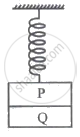
Two blocks P and Q of masses 0.3 kg and 0.4 kg, respectively, are stuck to each other by some weak glue as shown in the figure. They hang together at the end of a spring with a spring constant of k = 200 N/m. The block Q suddenly falls free due to the failure of glue, then the maximum kinetic energy of block P during subsequent motion will be ______ mJ.