Advertisements
Advertisements
प्रश्न
Why would an aircraft be unable to fly on the moon ?
Advertisements
उत्तर
Air is necessary for an aircraft to be able to fly. Aircraft cannot fly on moon in the absence of air as the pressure difference between the upper and lower part of the wing is required for producing lift. Moreover, air is also necessary to burn the fuel of the plane.
APPEARS IN
संबंधित प्रश्न
Two objects of masses 100 g and 200 g are moving along the same line and direction with velocities of 2 m s−1 and 1 m s−1, respectively. They collide and after the collision, the first object moves at a velocity of 1.67 m s−1. Determine the velocity of the second object.
Two objects, each of mass 1.5 kg are moving in the same straight line but in opposite directions. The velocity of each object is 2.5 m s−1 before the collision during which they stick together. What will be the velocity of the combined object after collision?
A shell of mass 0.020 kg is fired by a gun of mass 100 kg. If the muzzle speed of the shell is 80 m s–1, what is the recoil speed of the gun?
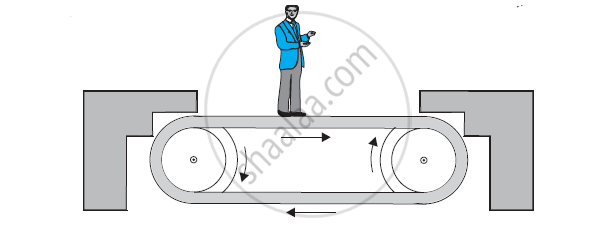
Figure shows a man standing stationary with respect to a horizontal conveyor belt that is accelerating with 1 m s–2. What is the net force on the man? If the coefficient of static friction between the man’s shoes and the belt is 0.2, up to what acceleration of the belt can the man continue to be stationary relative to the belt? (Mass of the man = 65 kg.)
Calculate the change in momentum of a body weighing 5 kg when its velocity decreases from 20 m/s to 0.20 m/s.
A man throws a ball weighing 500 g vertically upwards with a speed of 10 m/s.
- What will be its initial momentum ?
- What would be its momentum at the highest point of its flight ?
Fill in the following blanks with suitable words :
In collisions and explosions, the total _____________ remains constant, provided that no external _____________ acts.
Name the law involved in the following situation :
the sum of products of masses and velocities of two moving bodies before and after their collision remains the same.
A 150 g ball, travelling at 30 m/s, strikes the palm of a player’s hand and is stopped in 0.05 second. Find the force exerted by the ball on the hand.
Why are car seat-belts designed to stretch some what in a collision ?
