Advertisements
Advertisements
प्रश्न
Two objects, each of mass 1.5 kg are moving in the same straight line but in opposite directions. The velocity of each object is 2.5 m s−1 before the collision during which they stick together. What will be the velocity of the combined object after collision?
Advertisements
उत्तर
Mass of one of the objects, m1 = 1.5 kg
Mass of the other object, m2 = 1.5 kg
Velocity of m1 before collision, v1 = 2.5 m/s
Velocity of m2, moving in opposite direction before collision, v2 = −2.5 m/s
(Negative sign arises because mass m2 is moving in an opposite direction)
After collision, the two objects stick together.
Total mass of the combined object = m1 + m2
Velocity of the combined object = v
According to the law of conservation of momentum:
Total momentum before collision = Total momentum after collision
m1v1 + m2 v2 = (m1 + m2) v
1.5(2.5) + 1.5 (−2.5) = (1.5 + 1.5) v
3.75 − 3.75 = 3 v
v = 0
Hence, the velocity of the combined object after collision is 0 m/s.
संबंधित प्रश्न
An object of mass 1 kg travelling in a straight line with a velocity of 10 ms−1 collides with, and sticks to, a stationary wooden block of mass 5 kg. Then they both move off together in the same straight line. Calculate the total momentum just before the impact and just after the impact. Also, calculate the velocity of the combined object.
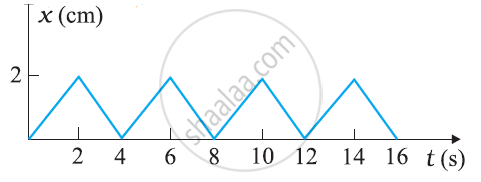
Figure shows the position-time graph of a body of mass 0.04 kg. Suggest a suitable physical context for this motion. What is the time between two consecutive impulses received by the body ? What is the magnitude of each impulse ?
Name the physical quantity which is considered to be a measure of the quantity of motion of a body.
What is the total momentum of the bullet and the gun before firing ?
Which physical quantity corresponds to the rate of change of momentum ?
Which physical principle is involved in the working of a jet aeroplane ?
A body of mass 2 kg is at rest. What should be the magnitude of force which will make the body move with a speed of 30 m/s at the end of 1 s ?
A gun of mass 3 kg fires a bullet of mass 30 g. The bullet takes 0.003 s to move through the barrel of the gun and acquires a velocity of 100 m/s. Calculate:
- the velocity with which the gin recoils.
- the force exerted on gunman due to recoil of the gun
A vessel at rest explodes into three pieces. Two pieces having equal masses fly-off perpendicular to one another with the same velocity 30 meter per second. The third piece has three times mass of each of other piece. The magnitude and direction of the velocity of the third piece will be
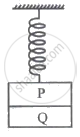
Two blocks P and Q of masses 0.3 kg and 0.4 kg, respectively, are stuck to each other by some weak glue as shown in the figure. They hang together at the end of a spring with a spring constant of k = 200 N/m. The block Q suddenly falls free due to the failure of glue, then the maximum kinetic energy of block P during subsequent motion will be ______ mJ.