Advertisements
Advertisements
प्रश्न
Two objects, each of mass 1.5 kg are moving in the same straight line but in opposite directions. The velocity of each object is 2.5 m s−1 before the collision during which they stick together. What will be the velocity of the combined object after collision?
Advertisements
उत्तर
Mass of one of the objects, m1 = 1.5 kg
Mass of the other object, m2 = 1.5 kg
Velocity of m1 before collision, v1 = 2.5 m/s
Velocity of m2, moving in opposite direction before collision, v2 = −2.5 m/s
(Negative sign arises because mass m2 is moving in an opposite direction)
After collision, the two objects stick together.
Total mass of the combined object = m1 + m2
Velocity of the combined object = v
According to the law of conservation of momentum:
Total momentum before collision = Total momentum after collision
m1v1 + m2 v2 = (m1 + m2) v
1.5(2.5) + 1.5 (−2.5) = (1.5 + 1.5) v
3.75 − 3.75 = 3 v
v = 0
Hence, the velocity of the combined object after collision is 0 m/s.
संबंधित प्रश्न
Two objects of masses 100 g and 200 g are moving along the same line and direction with velocities of 2 m s−1 and 1 m s−1, respectively. They collide and after the collision, the first object moves at a velocity of 1.67 m s−1. Determine the velocity of the second object.
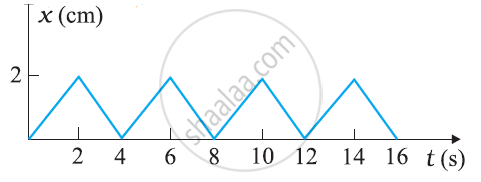
Figure shows the position-time graph of a body of mass 0.04 kg. Suggest a suitable physical context for this motion. What is the time between two consecutive impulses received by the body ? What is the magnitude of each impulse ?
Name the physical quantity which is considered to be a measure of the quantity of motion of a body.
state whether momentum is scalar or vector.
What is the total momentum of the bullet and the gun before firing ?
Explain the meaning of the following equation : .
p = m x v
where symbols have their usual meanings.
A body of mass 2 kg is at rest. What should be the magnitude of force which will make the body move with a speed of 30 m/s at the end of 1 s ?
Discuss the conservation of momentum in each of the following cases :
(i) a rocket taking off from ground.
(ii) flying of a jet aeroplane.
Why are car seat-belts designed to stretch some what in a collision ?
A monkey of mass 20 kg rides on a 40 kg trolley moving with constant speed of 8 m/s along a horizontal track If the monkey jumps vertically to grab the overhanging branch of a tree, the speed of the trolley after the monkey has jumped off is ______.
