Advertisements
Advertisements
प्रश्न
From a rifle of mass 4 kg, a bullet of mass 50 g is fired with an initial velocity of 35 m s−1. Calculate the initial recoil velocity of the rifle.
Advertisements
उत्तर
Mass of the rifle, m1 = 4kg
Mass of the bullet, m2 = 50g = 0.05 kg
Recoil velocity of the rifle = v1
Bullet is fired with an initial velocity, v2 = 35 m/s
Initially, the rifle is at rest.
Thus, its initial velocity, v = 0
Total initial momentum of the rifle and bullet system (m1 + m2)v = 0
Total momentum of the rifle and bullet system after firing:-
= m1v1 + m2v2 = 4(v1) + 0.05 x 35 = 4v1 + 1.75
According to the law of conservation of momentum:
Total momentum after the firing = Total momentum before the firing
4v1 + 1.75 =0
`v_1 = 1.75/4 =-0.4375" m/s"`
The negative sign indicates that the rifle recoils backwards with a velocity of 0.4375 m/s.
संबंधित प्रश्न
A nucleus is at rest in the laboratory frame of reference. Show that if it disintegrates into two smaller nuclei the products must move in opposite directions.
Two billiard balls, each of mass 0.05 kg, moving in opposite directions with speed 6 ms-1collide and rebound with the same speed. What is the impulse imparted to each ball due to the other?
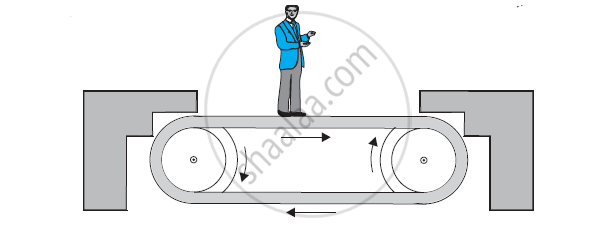
Figure shows a man standing stationary with respect to a horizontal conveyor belt that is accelerating with 1 m s–2. What is the net force on the man? If the coefficient of static friction between the man’s shoes and the belt is 0.2, up to what acceleration of the belt can the man continue to be stationary relative to the belt? (Mass of the man = 65 kg.)
Explain how, a karate player can break a pile of tiles with a single blow of his hand.
What is the change in momentum of a car weighing 1500 kg when its speed increases from 36 km/h to 72 km/h uniformly ?
Fill in the following blanks with suitable words :
Momentum is a _____________ quantity. Its unit is _____________.
The velocity of a body of mass 10 kg increases from 4 m/s to 8 m/s when a force acts on it for 2 s.
(a) What is the momentum before the force acts ?
(b) What is the momentum after the force acts ?
(c) What is the gain in momentum per second ?
(d) What is the value of the force ?
Why would an aircraft be unable to fly on the moon ?
A boy of mass 50 kg running at 5 m/s jumps on to a 20 kg trolley travelling in the same direction at 1.5 m/s. What is their common velocity ?
A monkey of mass 20 kg rides on a 40 kg trolley moving with constant speed of 8 m/s along a horizontal track If the monkey jumps vertically to grab the overhanging branch of a tree, the speed of the trolley after the monkey has jumped off is ______.
