Advertisements
Advertisements
प्रश्न
Fill in the following blanks with suitable words :
Momentum is a _____________ quantity. Its unit is _____________.
Advertisements
उत्तर
Momentum is a vector quantity. Its unit is kg.m/s.
APPEARS IN
संबंधित प्रश्न
Two objects of masses 100 g and 200 g are moving along the same line and direction with velocities of 2 m s−1 and 1 m s−1, respectively. They collide and after the collision, the first object moves at a velocity of 1.67 m s−1. Determine the velocity of the second object.
Two billiard balls, each of mass 0.05 kg, moving in opposite directions with speed 6 ms-1collide and rebound with the same speed. What is the impulse imparted to each ball due to the other?
Name the physical quantity which is considered to be a measure of the quantity of motion of a body.
state whether momentum is scalar or vector.
Name the physical quantity whose unit is kg.m/s.
What is the momentum in kg.m/s of a 10 kg car travelling at (a) 5 m/s (b) 20 cm/s, and (c) 36 km/h ?
Which physical principle is involved in the working of a jet aeroplane ?
A 150 g ball, travelling at 30 m/s, strikes the palm of a player’s hand and is stopped in 0.05 second. Find the force exerted by the ball on the hand.
The troops (soldiers) equipped to be dropped by parachutes from an aircraft are called paratroopers. Why do paratroopers roll on landing ?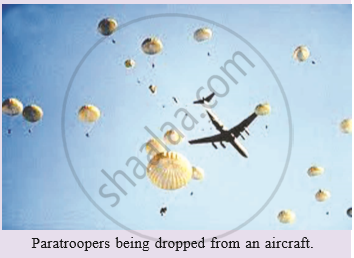
Why would an aircraft be unable to fly on the moon ?
