Advertisements
Advertisements
प्रश्न
The troops (soldiers) equipped to be dropped by parachutes from an aircraft are called paratroopers. Why do paratroopers roll on landing ?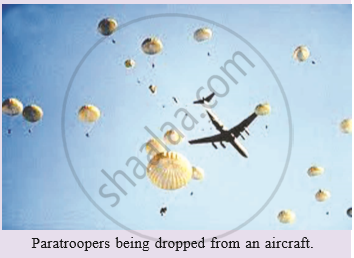
Advertisements
उत्तर
When a parachutist lands on the ground, the momentum he has is high enough to hurt him on hitting the ground. Rolling on the ground just after landing will convert the kinetic energy of fall into rotational energy which will be dissipated gradually by the friction of the ground. Thus, the parachutist will have a safe landing if he rolls on landing.
APPEARS IN
संबंधित प्रश्न
From a rifle of mass 4 kg, a bullet of mass 50 g is fired with an initial velocity of 35 m s−1. Calculate the initial recoil velocity of the rifle.
Two billiard balls, each of mass 0.05 kg, moving in opposite directions with speed 6 ms-1collide and rebound with the same speed. What is the impulse imparted to each ball due to the other?
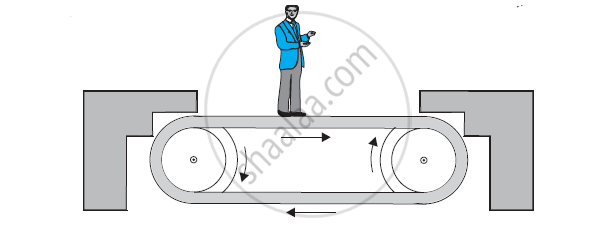
Figure shows a man standing stationary with respect to a horizontal conveyor belt that is accelerating with 1 m s–2. What is the net force on the man? If the coefficient of static friction between the man’s shoes and the belt is 0.2, up to what acceleration of the belt can the man continue to be stationary relative to the belt? (Mass of the man = 65 kg.)
state whether momentum is scalar or vector.
Calculate the momentum of a toy car of mass 200 g moving with a speed of 5 m/s.
A man throws a ball weighing 500 g vertically upwards with a speed of 10 m/s.
- What will be its initial momentum ?
- What would be its momentum at the highest point of its flight ?
A 10 g bullet travelling at 200 m/s strikes and remains embedded in a 2 kg target which is originally at rest but free to move. At what speed does the target move off ?
A body of mass 2 kg is at rest. What should be the magnitude of force which will make the body move with a speed of 30 m/s at the end of 1 s ?
Discuss the conservation of momentum in each of the following cases :
(i) a rocket taking off from ground.
(ii) flying of a jet aeroplane.
A ball X of mass 1 kg travelling at 2 m/s has a head-on collision with an identical ball Y at rest. X stops and Y moves off. Calculate the velocity of Y after the collision.
