Advertisements
Advertisements
प्रश्न
What is the momentum in kg.m/s of a 10 kg car travelling at (a) 5 m/s (b) 20 cm/s, and (c) 36 km/h ?
Advertisements
उत्तर
(a) 5 m/s
We know that:
Momentum = mass × velocity
= m × v
Here, mass, m = 10 kg
velocity, v = 5 m/s
Putting these values in the above formula, we get:
Momentum = 10 × 5 kg.m/s
= 50 kg.m/s
(b) 20 cm/s
We know that:
Momentum = mass × velocity
= m × v
Here, mass, m = 10 kg
velocity, v = 20 cm/s
v = 0.2 m/s
Putting these values in the above formula, we get:
Momentum = (10)(0.2) kg.m/s
= 2 kg.m/s
(c) 36 km/h
We know that:
Momentum = mass × velocity
= m × v
Here, mass, m = 10 kg
velocity, v = 36 km/h
= `36 xx 1000/3600`
= `36 xx 1000/3600`
= `36 xx 10/36`
= 10 m/s
Putting these values in the above formula, we get :
Momentum = 10 × 10 kg.m/s = 100 kg.m/s
APPEARS IN
संबंधित प्रश्न
An object of mass 1 kg travelling in a straight line with a velocity of 10 ms−1 collides with, and sticks to, a stationary wooden block of mass 5 kg. Then they both move off together in the same straight line. Calculate the total momentum just before the impact and just after the impact. Also, calculate the velocity of the combined object.
A nucleus is at rest in the laboratory frame of reference. Show that if it disintegrates into two smaller nuclei the products must move in opposite directions.
Two billiard balls, each of mass 0.05 kg, moving in opposite directions with speed 6 ms-1collide and rebound with the same speed. What is the impulse imparted to each ball due to the other?
Figure shows the position-time graph of a body of mass 0.04 kg. Suggest a suitable physical context for this motion. What is the time between two consecutive impulses received by the body ? What is the magnitude of each impulse ?
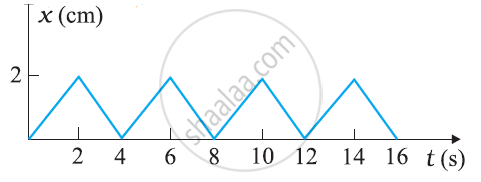
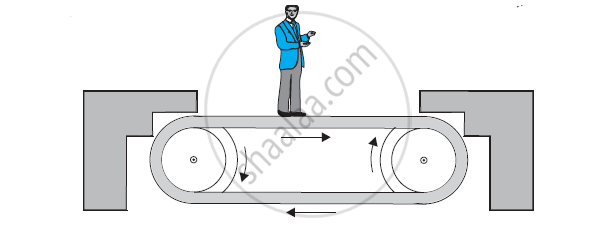
Figure shows a man standing stationary with respect to a horizontal conveyor belt that is accelerating with 1 m s–2. What is the net force on the man? If the coefficient of static friction between the man’s shoes and the belt is 0.2, up to what acceleration of the belt can the man continue to be stationary relative to the belt? (Mass of the man = 65 kg.)
What is the change in momentum of a car weighing 1500 kg when its speed increases from 36 km/h to 72 km/h uniformly ?
Define momentum of a body. On what factors does the momentum of a body depend ?
The velocity of a body of mass 10 kg increases from 4 m/s to 8 m/s when a force acts on it for 2 s.
(a) What is the momentum before the force acts ?
(b) What is the momentum after the force acts ?
(c) What is the gain in momentum per second ?
(d) What is the value of the force ?
Why would an aircraft be unable to fly on the moon ?
A 100 kg gun fires a ball of 1 kg horizontally from a cliff of height 500 m. It falls on the ground at a distance of 400 m from the bottom of the cliff. Find the recoil velocity of the gun. (acceleration due to gravity = 10 ms–2)
