Advertisements
Advertisements
Question
Two billiard balls, each of mass 0.05 kg, moving in opposite directions with speed 6 ms-1collide and rebound with the same speed. What is the impulse imparted to each ball due to the other?
Advertisements
Solution
Initial momentum of each ball before collision
= 0.05 x 6 kg ms-1 = 0.3 kg ms-1
Final momentum of each ball after collision
= -0.05 x 6 kg ms-1 = -0.3 kg ms-1 Impulse imparted to each ball due to the other
= final momentum - initial momentum = -0.3 kg m s-1 - 0.3 kg ms-1
= -0.6 kg ms-1 = 0.6 kg ms-1 (in magnitude)
The two impulses are opposite in direction.
APPEARS IN
RELATED QUESTIONS
From a rifle of mass 4 kg, a bullet of mass 50 g is fired with an initial velocity of 35 m s−1. Calculate the initial recoil velocity of the rifle.
Two objects of masses 100 g and 200 g are moving along the same line and direction with velocities of 2 m s−1 and 1 m s−1, respectively. They collide and after the collision, the first object moves at a velocity of 1.67 m s−1. Determine the velocity of the second object.
Two objects, each of mass 1.5 kg are moving in the same straight line but in opposite directions. The velocity of each object is 2.5 m s−1 before the collision during which they stick together. What will be the velocity of the combined object after collision?
What is the SI unit of momentum ?
What is the total momentum of the bullet and the gun before firing ?
Explain why, it is easier to stop a tennis ball than a cricket ball moving with the same speed.
Calculate the momentum of a toy car of mass 200 g moving with a speed of 5 m/s.
Which physical quantity corresponds to the rate of change of momentum ?
Which physical principle is involved in the working of a jet aeroplane ?
Name the principle on which a rocket works.
Fill in the following blanks with suitable words :
Momentum is a _____________ quantity. Its unit is _____________.
A gun of mass 3 kg fires a bullet of mass 30 g. The bullet takes 0.003 s to move through the barrel of the gun and acquires a velocity of 100 m/s. Calculate:
- the velocity with which the gin recoils.
- the force exerted on gunman due to recoil of the gun
The troops (soldiers) equipped to be dropped by parachutes from an aircraft are called paratroopers. Why do paratroopers roll on landing ?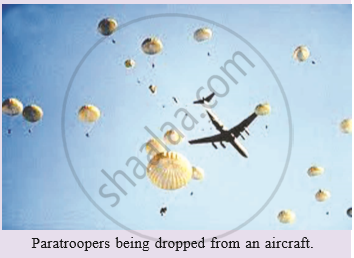
Explain why it is possible for a small animal to fall from a considerable height without any injury being caused when it reaches the ground.
A boy of mass 50 kg running at 5 m/s jumps on to a 20 kg trolley travelling in the same direction at 1.5 m/s. What is their common velocity ?
A girl of mass 50 kg jumps out of a rowing boat of mass 300 kg on to the bank, with a horizontal velocity of 3 m/s. With what velocity does the boat begin to move backwards ?
A ball X of mass 1 kg travelling at 2 m/s has a head-on collision with an identical ball Y at rest. X stops and Y moves off. Calculate the velocity of Y after the collision.
A vessel at rest explodes into three pieces. Two pieces having equal masses fly-off perpendicular to one another with the same velocity 30 meter per second. The third piece has three times mass of each of other piece. The magnitude and direction of the velocity of the third piece will be
A girl riding a bicycle along a straight road with a speed of 5 ms–1 throws a stone of mass 0.5 kg which has a speed of 15 ms–1 with respect to the ground along her direction of motion. The mass of the girl and bicycle is 50 kg. Does the speed of the bicycle change after the stone is thrown? What is the change in speed, if so?
