Advertisements
Advertisements
प्रश्न
Explain why, it is easier to stop a tennis ball than a cricket ball moving with the same speed.
Advertisements
उत्तर
It is easier to stop a tennis ball than a cricket ball moving with the same speed because it has less momentum than the cricket ball.
APPEARS IN
संबंधित प्रश्न
A nucleus is at rest in the laboratory frame of reference. Show that if it disintegrates into two smaller nuclei the products must move in opposite directions.
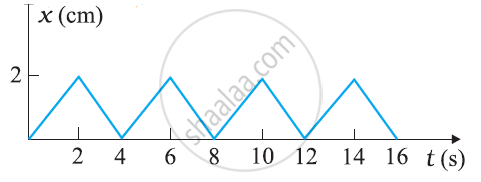
Figure shows the position-time graph of a body of mass 0.04 kg. Suggest a suitable physical context for this motion. What is the time between two consecutive impulses received by the body ? What is the magnitude of each impulse ?
What is the total momentum of the bullet and the gun before firing ?
Explain the meaning of the following equation : .
p = m x v
where symbols have their usual meanings.
Calculate the change in momentum of a body weighing 5 kg when its velocity decreases from 20 m/s to 0.20 m/s.
A plastic ball and a clay ball of equal masses, travelling in the same direction with equal speeds, strike against a vertical wall. From which ball does the wall receive a greater amount of momentum ?
Fill in the following blanks with suitable words :
Momentum is a _____________ quantity. Its unit is _____________.
Name the law involved in the following situation :
the sum of products of masses and velocities of two moving bodies before and after their collision remains the same.
State the law of conservation of momentum.
A girl of mass 50 kg jumps out of a rowing boat of mass 300 kg on to the bank, with a horizontal velocity of 3 m/s. With what velocity does the boat begin to move backwards ?
