Advertisements
Advertisements
प्रश्न
A batsman hits a cricket ball which then rolls on a level ground. After covering a short distance, the ball comes to rest. The ball slows to a stop because ______.
पर्याय
the batsman did not hit the ball hard enough.
velocity is proportional to the force exerted on the ball.
there is a force on the ball opposing the motion.
there is no unbalanced force on the ball, so the ball would want to come to rest.
Advertisements
उत्तर
A batsman hits a cricket ball which then rolls on a level ground. After covering a short distance, the ball comes to rest. The ball slows to a stop because there is a force on the ball opposing the motion.
Explanation:
- The cricket ball comes to a halt after a short distance because a force opposes the motion.
- This force is the result of both air resistance and friction between the ball and the ground.
संबंधित प्रश्न
State Newton’s first law of motion. Give two examples to illustrate Newton’s first law of motion.
A block of mass 10 kg is suspended from two light spring balances, as shown in the following figure.
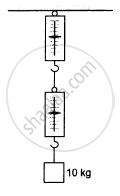
Three rigid rods are joined to form an equilateral triangle ABC of side 1 m. Three particles carrying charges 20 μC each are attached to the vertices of the triangle. The whole system is at rest in an inertial frame. The magnitude of the resultant force on the charged particle at A is.
A force F1 acts on a particle accelerating it from rest to a velocity v. Force F1 is then replaced by F2 which decelerates the particle to rest.
In an imaginary atmosphere, the air exerts a small force F on any particle in the direction of the particle's motion. A particle of mass m projected upward takes time t1 in reaching the maximum height and t2 in the return journey to the original point. Then.
A particle is found to be at rest when seen from a frame S1 and moving with constant velocity when seen from another frame S2. Mark out the possible options.
(a) Both the frames are inertial.
(b) Both the frames are non-inertial.
(c) S1 is inertial and S2 is non-inertial.
(d) S1 is non-inertial and S2 is inertial
A block of mass 2 kg placed on a long frictionless horizontal table is pulled horizontally by a constant force F. It is found to move 10 m in the first seconds. Find the magnitude of F.
Derive the relation between newton and dyne.
If the net force on an object is zero, what happens?
How is force defined according to Newton’s First Law?
