Advertisements
Advertisements
प्रश्न
What do you mean by inertia of motion?
Advertisements
उत्तर
The property by which a body neither changes its present state of rest or of uniform motion in a straight line nor tends to change the present state, is known as inertia.
APPEARS IN
संबंधित प्रश्न
A block of 2 kg is suspended from a ceiling by a massless spring of spring constant k = 100 N/m. What is the elongation of the spring? If another 1 kg is added to the block, what would be the further elongation?
When a train starts, the head of a standing passenger seems to be pushed backward. Analyse the situation from the ground frame. Does it really go backward? Coming back to the train frame, how do you explain the backward movement of the head on the basis of Newton's laws?
'When a hanging carpet is beaten with a stick, the dust particles start coming out of it'. This phenomenon can be best explained by making use of :
Give one example each of inertia of rest and inertia of motion.
The greater is the __________ the greater is the inertia of an object.
A body of mass 10 kg is acted upon by two perpendicular forces, 6 N and 8 N. The resultant acceleration of the body is ______.
- 1 m s–2 at an angle of tan−1 `(4/3)` w.r.t 6 N force.
- 0.2 m s–2 at an angle of tan−1 `(4/3)` w.r.t 6 N force.
- 1 m s–2 at an angle of tan−1 `(3/4)` w.r.t 8 N force.
- 0.2 m s–2 at an angle of tan−1 `(3/4)` w.r.t 8 N force.
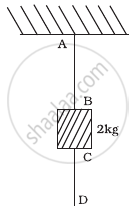
A mass of 2 kg is suspended with thread AB (Figure). Thread CD of the same type is attached to the other end of 2 kg mass. Lower thread is pulled gradually, harder and harder in the downward directon so as to apply force on AB. Which of the threads will break and why?
Two blocks A and B of masses m and 2 m, respectively, are held at rest such that the spring is in natural length. Find out the accelerations of both the blocks just after release.

What is the significance of Newton’s first law?
What does inertia measure in an object?
