Advertisements
Advertisements
प्रश्न
Write the answer of the question with reference to laws of gravitation.
State the universal law of gravitation.
State Newton’s law of gravitation.
State Newton’s Universal Law of Gravitation.
Advertisements
उत्तर
The universal law of gravitation states that every object in the universe attracts every other object with a force called the gravitational force. The force acting between two objects is directly proportional to the product of their masses and inversely proportional to the square of the distance between their centres.
F ∝ m M (masses of two bodies m and M)
F ∝ `1/"d"^2` (d is the distance between the two bodies.)
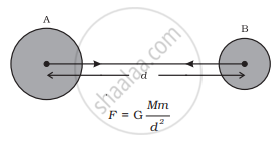
A and B are two bodies, the distance between which is given as d.
F = force with which one body is attracting the other.
G = proportionality constant.
APPEARS IN
संबंधित प्रश्न
Write the formula to find the magnitude of the gravitational force between the earth and an object on the surface of the earth.
The earth and the moon are attracted to each other by gravitational force. Does the earth attract the moon with a force that is greater or smaller or the same as the force with which the moon attracts the earth? Why?
If the moon attracts the earth, why does the earth not move towards the moon?
What happens to the force between two objects, if the mass of one object is doubled?
What happens to the force between two objects, if the distance between the objects is doubled and tripled?
What happens to the force between two objects, if the masses of both objects are doubled?
If you compare the gravitational force on the Earth due to the Sun to that due to the Moon, you would find that the Sun’s pull is greater than the Moon’s pull. (You can check this yourself using the data available in the succeeding exercises). However, the tidal effect of the Moon’s pull is greater than the tidal effect of Sun. Why?
Choose the correct alternative:
Acceleration due to gravity is independent of mass of the earth/mass of the body.
A rocket is fired from the earth towards the sun. At what distance from the earth’s centre is the gravitational force on the rocket zero? Mass of the sun = 2 ×1030 kg, mass of the earth = 6 × 1024 kg. Neglect the effect of other planets etc. (orbital radius = 1.5 × 10¹¹ m).
State two applications of universal law of gravitation.
State the universal law of gravitation. Name the scientist who gave this law.
Universal law of gravitation states that every object exerts a gravitational force of attraction on every other object. If this is true, why don’t we notice such forces ? Why don’t the two objects in a room move towards each other due to this force ?
Write the three laws given by Kepler. How did they help Newton to arrive at the inverse square law of gravity?
A person brings a mass of 1 kg from infinity to a point A. Initially the mass was at rest but it moves at a speed of 2 m s −1 as it reaches A. The work done by the person on the mass is −3 J. The potential at A is
Let V and E be the gravitational potential and gravitational field at a distance r from the centre of a uniform spherical shell. Consider the following two statements :
(A) The plot of V against r is discontinuous.
(B) The plot of E against r is discontinuous.
Inside a uniform spherical shell
(a) the gravitational potential is zero
(b) the gravitational field is zero
(c) the gravitational potential is same everywhere
(d) the gravitational field is same everywhere
Three equal masses m are placed at the three corners of an equilateral triangle of side a. Find the force exerted by this system on another particle of mass m placed at (a) the mid-point of a side, (b) at the centre of the triangle.
Two small bodies of masses 10 kg and 20 kg are kept a distance 1.0 m apart and released. Assuming that only mutual gravitational forces are acting, find the speeds of the particles when the separation decreases to 0.5 m.
A tunnel is dug along a chord of the earth at a perpendicular distance R/2 from the earth's centre. The wall of the tunnel may be assumed to be frictionless. Find the force exerted by the wall on a particle of mass m when it is at a distance x from the centre of the tunnel.
The law of gravitation gives the gravitational force between :
The acceleration produced by a force in an object is directly proportional to the applied _________ And inversely proportional to the _________ Of the object.
Who stated the law of gravitation?
Distinguish between gravity and gravitation
How will the force of gravitation between two objects change if the distance between them is:
Halved
How will the force of gravitation between two objects change if the distance between them is:
Doubled
How will the force of gravitation between two objects change if the distance between them is:
Infinite
All objects in the universe attract each other along the line joining their________.
The force of attraction between any two material objects is called __________.
Is the law of gravitation applicable in case of the sun and the moon?
A ball is thrown up with a speed of 4.9 ms-1.
Calculate the maximum height it would gain before it begins to fall.
At what height above the earth's surface would the value of acceleration due to gravity be half of what it is on the surface? Take the radius of earth to be R.
What does a force do in the following case?
You pull the skin of your arm
What does a force do in the following case?
You twist a piece of rubber.
Name and state the action and reaction in the following case:
A person walking on the ground.
Name and state the action and reaction in the following case:
Hammering a nail.
State Newton's law of gravitation. What is the difference between:
g and G?
The distance-time values for an object moving along straight line are given below:
| Time (s) | Distance (m) |
| 0 | 0 |
| 1 | 1 |
| 2 | 8 |
| 3 | 27 |
Answer the following question.
What are the dimensions of the universal gravitational constant?
The gravitational force between two bodies is directly proportional to the product of the masses of those bodies and is ______ of the distance between them.
The value of universal gravitational constant (G) in the SI unit is ______.
State the universal law of gravitation and derive its mathematical expression.
For the weight of body of mass 5 kg to be zero on equator of the earth, angular velocity of the earth must be (The radius of earth = 6400 km, acceleration due to gravity = 10 m/s2).
Law of gravitation gives the gravitational force between
As observed from earth, the sun appears to move in an approximate circular orbit. For the motion of another planet like mercury as observed from earth, this would ______.
Different points in earth are at slightly different distances from the sun and hence experience different forces due to gravitation. For a rigid body, we know that if various forces act at various points in it, the resultant motion is as if a net force acts on the c.m. (centre of mass) causing translation and a net torque at the c.m. causing rotation around an axis through the c.m. For the earth-sun system (approximating the earth as a uniform density sphere).
Particles of masses 2M, m and M are respectively at points A, B and C with AB = ½ (BC). m is much-much smaller than M and at time t = 0, they are all at rest (Figure). At subsequent times before any collision takes place ______.

Molecules in air in the atmosphere are attracted by gravitational force of the earth. Explain why all of them do not fall into the earth just like an apple falling from a tree.
We can shield a charge from electric fields by putting it inside a hollow conductor. Can we shield a body from the gravitational influence of nearby matter by putting it inside a hollow sphere or by some other means?
The gravitational force between a hollow spherical shell (of radius R and uniform density) and a point mass is F. Show the nature of F vs r graph where r is the distance of the point from the centre of the hollow spherical shell of uniform density.
Write the answer of the question with reference to laws of gravitation.
Write the value of the universal gravitational constant.
Newton's universal law of gravitation applies to ______.
If three equal masses m are placed at the three vertices of an equilateral triangle of side 1/m then what force acts on a particle of mass 2m placed at the centroid?
If the mass of one object is doubled and distance remains the same, the gravitational force will ______.
Ocean tides on Earth are mainly caused by ______.
The Superposition Principle states that the net gravitational force on an object is ______.
Who measured the value of the Universal Gravitational Constant G using the Cavendish balance?
For an object outside a uniform solid sphere, from where is the sphere's mass considered to act?
