Advertisements
Advertisements
प्रश्न
The gravitational field in a region is given by \[E = \left( 2 \overrightarrow{i} + 3 \overrightarrow{j} \right) N {kg}^{- 1}\] . Show that no work is done by the gravitational field when a particle is moved on the line 3y + 2x = 5.
[Hint : If a line y = mx + c makes angle θ with the X-axis, m = tan θ.]
Advertisements
उत्तर
The gravitational field in a region is given by \[\overrightarrow{E} = 2 \hat i + 3 \hat j\]
Slope of the electric field, \[m_1 = \tan \theta_1 = \frac{3}{2}\]
The given line is 3y + 2x = 5.
Slope of the line, \[m_2 = \tan \theta_2 = - \frac{2}{3}\]
We can see that m1m2 = −1
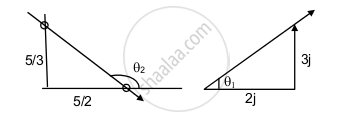
Since the directions of the field and the displacement are perpendicular to earth other, no work is done by the gravitational field when a particle is moved on the given line.
APPEARS IN
संबंधित प्रश्न
The earth and the moon are attracted to each other by gravitational force. Does the earth attract the moon with a force that is greater or smaller or the same as the force with which the moon attracts the earth? Why?
Choose the correct alternative:
Acceleration due to gravity increases/decreases with increasing depth. (assume the earth to be a sphere of uniform density).
How will you ‘weigh the sun’, that is estimate its mass? The mean orbital radius of the earth around the sun is 1.5 × 10⁸ km.
State Kepler’s law which is represented by the relation r3 ∝ T2.
Can we apply Newton’s third law to the gravitational force ? Explain your answer.
At noon, the sun and the earth pull the objects on the earth's surface in opposite directions. At midnight, the sun and the earth pull these objects in same direction. Is the weight of an object, as measured by a spring balance on the earth's surface, more at midnight as compared to its weight at noon?
Let V and E represent the gravitational potential and field at a distance r from the centre of a uniform solid sphere. Consider the two statements:
(A) the plot of V against r is discontinuous.
(B) The plot of E against r is discontinuous.
Explain the following:
People often shake the branches of a tree for getting down its fruits.
Write an expression for the gravitational force of attraction between two bodies of masses m1 and m2 separated by a distance r.
A ball is thrown up with a speed of 4.9 ms-1.
Calculate the time it takes to reach this height.
What does a force do in the following case?
You apply brakes to a running car.
You can change the direction in which an object is moving by___________.
State the law of gravitation. Why is it called universal?
Explain why:
The atmosphere does not escape.
Is there a gravitational attraction between you and the book? Explain.
An apple falls towards the earth due to its gravitational force. The apple also attracts the earth with the same force. Why do we not see the earth rising towards the apple? Explain.
Answer the following question.
What are the dimensions of the universal gravitational constant?
Solve the following problem.
Find the gravitational force between the Sun and the Earth.
Given Mass of the Sun = 1.99 × 1030 kg
Mass of the Earth = 5.98 × 1024 kg
The average distance between the Earth and the Sun = 1.5 × 10¹¹ m.
How is the gravitational force between two point masses affected when they are dipped in water keeping the separation between them the same?
If the mass of one object is doubled and distance remains the same, the gravitational force will ______.
